
Rahu and Ketu in Navamsa: Your Spouse's Hidden Demands
Published 4 July 2026 · By OrbitVeda Editorial · Updated 4 July 2026
Marriage is often described as a sacred union, but in the real world, it carries an undeniable element of exchange. When a person enters your life as a spouse, they come with a set of expectations. These expectations are rarely random. They are written into the karmic blueprint of your D9 Navamsa chart, specifically in the placement of Rahu and Ketu. The birth chart shows the seed, the potential, but the Navamsa reveals the fruit. An astrologer may look at your D1 and declare that the seventh lord is afflicted or that Venus is weak, yet your marriage still survives and even thrives. The answer to that mystery lies in the D9. Rahu in the Navamsa tells you exactly what your partner wants from you. When you understand that demand and consciously work to fulfil it, the relationship stabilises. When you ignore it or fight against it, the bond fractures. This article decodes every Rahu‑Ketu axis in the Navamsa, house by house, so you can see the hidden contract your spouse signed with you before either of you were born.
Rahu in the 1st House and Ketu in the 7th House of the D9 Navamsa
The Core Demand: Validation and Confidence
When Rahu occupies the first house of the Navamsa and Ketu sits in the seventh, your partner enters your life seeking validation. On the outside, this person may appear exceptionally strong and confident. The world speaks highly of them. But when you connect with them one‑on‑one, you sense an emptiness, a quiet insecurity that they hide from everyone else. Your role in this marriage is to be the growth magnet. You are the person who boosts their confidence, who makes them feel seen and valued. If you can consistently provide that validation, the relationship will hold. If you instead question them, criticise them, or point out their flaws before they are ready to hear them, you will shatter the very thing they came to you for.
When Rahu Is Supported by Benefics
If Rahu in the first house is well placed, conjoined with a benefic like Venus or Mercury, or sitting in a friendly sign, you will naturally radiate a personality that uplifts others. The moment someone enters your life, you will speak to them in a way that makes them feel better about themselves. Your presence alone acts as a confidence boost. This is what draws people to you, and it is what sustains your marriage. The partner who came seeking validation will receive it effortlessly, and the bond will deepen.
When Rahu Is Afflicted
If Rahu in the first house is afflicted by a malefic, placed in a sign like Leo where ego dominates, or caught in a retrograde or combust combination, the dynamic flips. Your first instinct will not be to validate but to challenge. You will point out what is missing, question their abilities, and leave them feeling smaller than when they arrived. The world will still praise your spouse, but you will remain unconvinced. The marriage becomes a quiet battlefield of unmet emotional needs. The partner who came for confidence will leave with less than they started with.
Post‑Marriage Transformation
After marriage, a person with this axis often discovers that their own confidence grows in direct proportion to the confidence they give their spouse. The act of validating another person teaches you how to validate yourself. Outsiders will continue to admire your partner, but you will slowly learn to see the strength in them that everyone else already sees. When Rahu is well placed, this is one of the most fulfilling journeys a marriage can offer.
Rahu in the 2nd House and Ketu in the 8th House of the D9 Navamsa
The Core Demand: Financial and Emotional Security
When Rahu occupies the second house and Ketu the eighth, the primary demand from your partner revolves around security. This is not a shallow demand. It arises from a deep place, often from a family history marked by trauma, financial instability, sudden losses, or health crises. Your partner will ask you about your income, your savings, your insurance, whether you own a home. These questions may feel transactional, but they are the surface expression of a soul that has known too much uncertainty. The core karmic goal of this axis is to bring two families closer together and to build a foundation of safety that neither partner had before.
The Role of Speech and Family
The second house also governs speech, not communication in the broad sense, but the art of talking, the tone, the choice of words. Your partner will be deeply affected by how you speak. A harsh word or a dismissive tone can wound them more than you realise. Conversely, learning to speak with warmth and care can heal wounds that you did not create. Growth in this marriage comes when you develop the ability to speak in a way that makes others, especially your spouse, feel secure. If you invest in improving your speech, perhaps by learning a new language or simply by becoming more conscious of your words, you will see not only your marriage improve but your career prospects expand as well.
When Rahu Is Supported and When It Is Afflicted
If Rahu is in a friendly sign like Gemini or Virgo, or conjoined with Mercury or Venus, you will find it easy to provide the financial and emotional security your partner seeks. You will be naturally inclined to save, to plan, and to speak gently. If Rahu is in a sign like Leo, where ego dominates, you will react defensively to any question about your finances. You will interpret your partner’s need for security as an attack on your status. The conversation that was meant to build trust will instead become a power struggle.
Post‑Marriage Transformation
After marriage, the native with this axis often experiences a marked improvement in financial stability. The very act of committing to a partner forces a new level of responsibility. Savings increase, investments become more structured, and the chaotic financial patterns of the past begin to settle. The relationship becomes a vehicle for material consolidation, but only if the native accepts the demand for security rather than resisting it.
Rahu in the 3rd House and Ketu in the 9th House of the D9 Navamsa
The Core Demand: Communication, Effort and Learning
When Rahu sits in the third house and Ketu in the ninth, the marriage becomes a learning partnership. Your partner will demand that you communicate, that you make an effort, and that you be willing to learn new things. They may ask about your communication skills, your business, or simply observe how much initiative you take. This axis often appears in charts where the native experienced loneliness in their early years, particularly in their educational phase. The partner enters to fill that gap, to create a shared life where both people evolve through dialogue and mutual effort.
The Karmic Story and Love Marriage
The third house is the house of effort and communication, and it is also the eleventh from the fifth. Because of this, it is one of the key houses for love marriage and romantic relationships. The demand here is not for grand gestures but for consistent, everyday effort. Your partner wants to see that you are trying. They want to see that you are improving your communication, that you are learning new skills, that you are not stagnating. If you can show that you are growing, the relationship thrives. If you become complacent and stop making an effort, the bond weakens.
Ideological Conflicts and the Role of the Guru
With Ketu in the ninth house, there is a karmic pull toward ideological disagreements. The partner may challenge your beliefs, your philosophy, or your spiritual views. This is not meant to break the marriage but to refine your understanding. If you are an astrologer or a tarot reader and you try to dominate your partner with your knowledge, you will create conflict. The lesson is to share wisdom without imposing it. When you respect your partner’s worldview, even when it differs from your own, the ninth house Ketu transforms from a source of conflict into a source of deep spiritual connection.
Post‑Marriage Transformation
After marriage, people with this axis often surprise themselves by learning things they never thought they would. Someone who could not drive learns to drive. Someone who was not tech‑savvy learns to use new devices. The relationship becomes a classroom, and the native emerges more skilled, more adaptable, and more confident in their ability to learn.
Rahu in the 4th House and Ketu in the 10th House of the D9 Navamsa
The Core Demand: Emotional Comfort
The fourth‑tenth axis is the most complex of all the Rahu‑Ketu placements in the Navamsa. When Rahu is in the fourth house, your partner demands emotional comfort above all else. They want a peaceful home, a beautiful house, a good car, and a sense of emotional security that they may never have experienced in their own family. They want you to create an environment where they can finally exhale. This is a heavy set of demands, and it is why this axis can feel overwhelming. The partner is often a highly career‑driven person who has neglected their own emotional world, and now they turn to you to fill that void.
The Danger of Unmet Emotional Needs
When the native cannot provide emotional comfort, the partner slowly drifts away. They may not leave physically, but the emotional distance becomes palpable. This axis demands that you prioritise your partner’s inner peace. If you live in a joint family where the environment is stressful, consider creating physical or emotional distance from the larger family unit. Your partner needs a sanctuary, and if you cannot provide it, someone else eventually will.
Post‑Marriage Transformation
After marriage, the native with Rahu in the fourth often finds that their home environment improves, sometimes through relocation or renovation. There is a shift from chaos to calm. The partner’s presence, once the demand for comfort is met, becomes the anchor that allows the native to thrive in other areas of life.
Rahu in the 10th House and Ketu in the 4th House of the D9 Navamsa
The Core Demand: Career Success and Public Status
If Rahu is in the tenth house and Ketu in the fourth, the demand shifts. Here, your partner cares less about emotional comfort and more about your professional standing. They want to see you succeed in your career. They want you to have a good name, a good status, and public respect. The pressure is on your professional life, not your home life. This is a comparatively easier axis to manage, provided your career is on track. If you are thriving at work, the marriage feels stable. If your career falters, the relationship may feel the strain.
Post‑Marriage Transformation
After marriage, the native often experiences a boost in their professional life. Promotions, new opportunities, and increased public recognition are common. The partner’s presence, and the desire to meet their expectations, becomes a powerful motivator for career growth.
Rahu in the 5th House and Ketu in the 11th House of the D9 Navamsa
The Core Demand: Love, Creativity and Prioritisation
When Rahu occupies the fifth house and Ketu the eleventh, the marriage is fundamentally about love. Your partner demands your affection, your creativity, and most importantly, your time. This is perhaps the gentlest axis of all, because the demand is for something that should naturally exist in a marriage. Your partner wants to feel loved, romanced, and prioritised. They want to know that they matter more than your friends, more than your extended family, and more than your social obligations.
The Shadow of the Friend Circle
Ketu in the eleventh house creates a karmic requirement for distance from the friend circle and large social networks. The marriage will demand that you reduce your time with friends and increase your time with your spouse. If your social circle is vast, with hundreds of people who rely on you, this marriage will struggle. If your circle is small and you are naturally able to prioritise your partner, the marriage will thrive. The partner may have experienced loneliness in their early years, especially during their educational phase, and they are now seeking in you the companionship they missed.
When Rahu Is Supported and When It Is Afflicted
If Rahu in the fifth is well placed, in a friendly sign, or conjoined with a benefic planet, you will naturally be creative, expressive, and capable of deep devotion. You will find joy in prioritising your partner, and the relationship will flourish. If Rahu is afflicted, perhaps in Leo with the Sun, or under the aspect of a malefic, the native will resist. They will say, “I do not have time. I am not a creative person. I cannot give you the attention you deserve.” The demand for love will go unmet, and the marriage will suffer.
Post‑Marriage Transformation
After marriage, the native with this axis often discovers that their creative abilities expand. They may develop new artistic talents, find joy in romantic expression, and experience a deepening of emotional intimacy. The relationship becomes a canvas on which they paint their love.
Rahu in the 6th House and Ketu in the 12th House of the D9 Navamsa
The Core Demand: Service, Help and Sacrifice
When Rahu occupies the sixth house and Ketu the twelfth, your partner comes to you seeking help. They want you to solve their problems, to fix what is broken, to be of service. This axis makes you a problem‑solver in the relationship. Your partner will approach you with issues, and your ability to resolve them determines the health of the marriage. This is also the axis of sacrifice. The twelfth house calls for devotion, letting go, and sometimes physical or emotional distance. Your partner may demand that you spend on them, that you support them financially, or that you accept a long‑distance relationship.
The Demand for Research and Depth
With Ketu in the twelfth, there is often a pull toward spirituality, foreign lands, or deep inner work. Your partner may want you to be a researcher, a healer, or someone who has profound knowledge of a subject. If you are an astrologer, a tarot reader, or someone who has pursued a PhD, your partner will feel magnetically drawn to that depth. You become the guru they were looking for. If, however, you present yourself as someone who knows nothing of depth, the attraction fades.
When Rahu Is Supported
If Rahu in the sixth is well placed, in a friendly sign like Gemini or Virgo, you will naturally respond to your partner’s requests with willingness. “Yes, I can help you.” That simple answer, given without resentment, keeps the relationship alive. If you find yourself irritated by every request, saying “Why do you always need my help?” the marriage will crumble. The karmic lesson of this axis is selfless service followed by surrender, and those who learn it find that their relationships become deeply fulfilling.
Post‑Marriage Transformation
After marriage, the native with this axis often finds that their interest in spirituality, healing, or research deepens. They may take up meditation, astrology, or other esoteric studies. The relationship becomes the catalyst for a profound inner journey.
Rahu in the 7th House and Ketu in the 1st House of the D9 Navamsa
The Core Demand: Ideal Partnership and Initiative
When Rahu occupies the seventh house and Ketu the first, the partner demands an ideal spouse. They want you to be the one who takes initiative, who makes the plans, who pays the bills, and who puts effort into the relationship. The partner themselves may be passive, waiting for you to lead. This can be frustrating, but it is the karmic contract you signed. Your role is to be the giver in the partnership without keeping score.
The Trap of Tit‑for‑Tat
The greatest danger with this axis is falling into the mindset of “If they are not trying, why should I?” Your partner may not message first, may not initiate dates, and may not appear to be making an effort. If you respond by withdrawing your own effort, the marriage stalls. The moment you stop keeping score and simply give from your side, the relationship stabilises. This axis works best when you adopt the attitude of doing your part regardless of what the other person does.
Post‑Marriage Transformation
After marriage, the native often discovers side hustles, new business ventures, and a renewed sense of purpose in fulfilling their partner’s desires. The act of becoming an ideal partner spills over into professional life, where they become more proactive, more confident, and more successful.
Rahu in the 8th House and Ketu in the 2nd House of the D9 Navamsa
The Core Demand: Intensity, Secrecy and Depth
When Rahu occupies the eighth house and Ketu the second, the partner demands intensity. They want deep emotional support, magnetic attraction, and a sense of mystery. They do not want you to be an open book who shares everything with everyone. They want you to be someone who knows much but speaks little, someone with hidden depths. This axis thrives on the tension between secrecy and revelation. If you are a person who researches, who studies the occult, or who has a magnetic, slightly secretive personality, your partner will be drawn to you irresistibly.
The Danger of Sudden Separation
The eighth house is the house of sudden breaks, and the second house governs family and speech. The karmic story of this axis often involves a past life where information was hidden or where a relationship ended abruptly because of a discovered secret. To avoid repeating that pattern, you must learn to balance what you reveal and what you keep private. You do not need to hide things from your partner, but you do not need to broadcast everything to the world either. A controlled, composed personality sustains this marriage.
Post‑Marriage Transformation
After marriage, the native may find that stuck ancestral property disputes get resolved, or that long‑held secrets within the family come to light in a way that ultimately brings healing. The eighth house energy, when channelled correctly, transforms hidden trauma into liberation.
Rahu in the 9th House and Ketu in the 3rd House of the D9 Navamsa
The Core Demand: Guidance, Mentorship and Wisdom
When Rahu occupies the ninth house and Ketu the third, your partner comes to you seeking a guru. They want guidance, mentorship, and someone who can help them navigate life. This is a deeply karmic placement, often indicating a past life where a love marriage or an unconventional relationship failed because of societal or religious opposition. In this life, the native must choose between following the path of society or following the path of the heart.
The Transformative Power of This Axis
Rahu in the ninth house is often said to be in its marana karaka sthana, a difficult placement. Yet in the context of marriage, it can be profoundly transformative. The partner who enters your life will change everything. Your entire worldview may shift. You may find yourself becoming more spiritual, more philosophical, or more devoted to a higher purpose. This axis demands that you represent yourself as a teacher, a mentor, or a spiritual guide, not only to your spouse but to the world. When you embrace that role, the marriage becomes a source of immense fulfilment.
Rahu in the 11th House and Ketu in the 5th House of the D9 Navamsa
The Core Demand: Friendship Over Romance
When Rahu occupies the eleventh house and Ketu the fifth, the demand is unusual: your partner wants you to be their friend more than their romantic partner. They want a friendly environment, shared social circles, and a relationship that feels more like a companionship than a traditional marriage. This can be a challenging axis because the fifth house Ketu signals a past life where romance was fully experienced but friendship was lacking. Now, the soul craves the missing piece.
Post‑Marriage Transformation
After marriage, the native who embraces the friendly dynamic finds that their network expands, their social life improves, and their relationship takes on a light, joyful quality. Those who resist and try to force a more traditional, hierarchical marriage structure may find themselves disappointed.
Rahu in the 12th House and Ketu in the 6th House of the D9 Navamsa
The Core Demand: Expenditure, Spirituality and Solitude
When Rahu occupies the twelfth house and Ketu the sixth, the partner demands expenditure. They want you to spend on them, to invest in experiences, and sometimes to support them financially. They may also demand a long‑distance relationship, a spiritual journey together, or periods of solitude. This axis is about sacrifice and devotion. The partner may say, “I want to explore my life. I want to travel. I want you to support me in this.” If you can accommodate those demands, the marriage thrives. If you resist, the distance grows.
Favourable and Unfavourable Placements for Rahu in the Navamsa
Rahu performs well in the signs of Mercury (Gemini and Virgo), Venus (Taurus and Libra), and Jupiter (Sagittarius and Pisces). In these signs, the demands of the partner are met with ease, and the native naturally adapts to the karmic contract. Rahu also performs well in houses two, three, six, seven, ten, and eleven, where its expansive energy finds constructive outlets.
Rahu struggles in the signs of the Sun (Leo) and the Moon (Cancer), where ego and emotional volatility interfere with the relationship. The sign of Mars (Aries and Scorpio) can also be challenging, as it introduces aggression, disputes, and sometimes emotional or physical abuse, particularly if Rahu and Mars are conjoined in these signs. Among the conjunctions, Rahu with Venus is generally favourable, bringing freedom and fluidity to the relationship. Rahu with Mercury supports planning and intellectual bonding. Rahu with Jupiter encourages spiritual growth. Rahu with Mars, however, demands caution, as it can create controlling or possessive behaviour, especially if Mars is debilitated. Rahu with the Sun is the most difficult, as it inflates ego to a point where the native cannot accept the partner’s demands at all. Rahu with Saturn, on the other hand, is a strong combination that brings responsibility and the eventual resolution of karmic debts.
Conclusion
The Navamsa chart does not tell you whether you will marry. It tells you what kind of marriage you will have, and what you must do to sustain it. Rahu sits in your D9 like a silent partner, holding the list of demands your future spouse will bring. If you meet those demands, the marriage works, regardless of what the birth chart says about your seventh lord or Venus. If you refuse, even the strongest planetary combinations cannot save the bond. The secret to a lasting relationship is not found in finding the perfect partner. It is found in understanding what your partner needs from you, and deciding, consciously, to provide it. When you become the person your spouse was searching for, the marriage ceases to be a battlefield of unmet expectations and becomes the sacred, growth‑filled union it was always meant to be.
Frequently Asked Questions
Why does my marriage survive despite negative indications in my birth chart?+
The birth chart shows the overall promise, but the Navamsa shows the actual fruit. If Rahu is well placed in your D9 and you are consciously meeting your partner's core demands, the marriage can survive and even thrive despite afflictions in the D1. The Navamsa holds the deeper karmic contract that overrides superficial difficulties.
How can I know what my partner truly wants from me?+
Look at the house where Rahu sits in your Navamsa chart. That house reveals the core demand. If Rahu is in the second house, the demand is financial and emotional security. If it is in the fifth house, the demand is love and attention. Understanding this placement helps you see what your partner is unconsciously seeking from you.
Is it true that Rahu in the first house of Navamsa can attract a spouse who hides a part of their identity?+
When Rahu in the first house is afflicted, specifically by malefics or placed in difficult signs like Leo or Scorpio, the partner may keep significant aspects of their life hidden. This can include their sexuality, past relationships, or other personal truths. The native may feel that the world admires their spouse but something essential remains concealed.
Does Rahu in the eighth house always mean problems in marriage?+
No. Rahu in the eighth house, when well placed with benefics like Mercury or Venus, can create a magnetic, deeply intimate bond. It can also bring resolution to long‑standing financial or ancestral issues after marriage. The key is to embrace depth, research, and a certain controlled mystery in your personality rather than resisting the eighth house energy.
Can I change the way Rahu affects my marriage if the placement is difficult?+
Yes. The Rahu‑Ketu axis shows the demand, but you always have the choice to meet it or resist it. If Rahu is afflicted, the sign and the accompanying planets make it harder to fulfil the demand, but awareness is the first step toward change. Conscious effort to provide what your partner needs, combined with remedial measures for the afflicted planets, can gradually transform the relationship.
More Marriage Articles
Related guides on compatibility, timing, and interpretation.
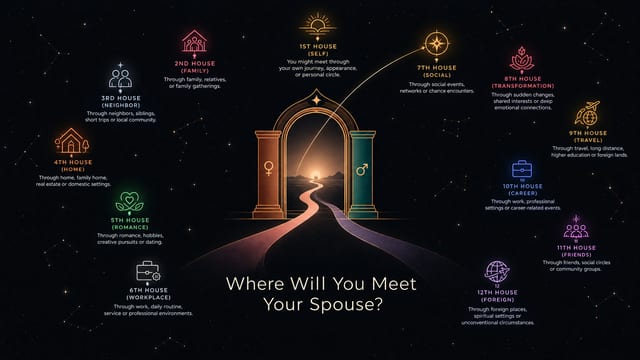
Marriage
Where Will You Meet Your Spouse? The 7th House Lord in All 12 Houses
Where will you meet your future spouse? The placement of your 7th house lord holds the answer — from family gatherings, social media, and the workplace to temples, weddings, and long journeys. Here is what each of the 12 house placements means for your meeting.
11 Oct 2026
Marriage
Venus in the 12 Zodiac Signs: Love, Marriage & Relationship Meaning
Learn how your Venus sign reveals the past, present and future of your relationships using the Vedic trikona principle. Discover what the 5th and 9th signs from Venus say about love, marriage, karmic connections and your relationship's long-term destiny.
9 Jul 2026
Marriage
Signs of Divorce and Separation in Vedic Astrology
This guide explains the most important Vedic astrology combinations linked to marital breakdown, including combust Venus, Rahu, Ketu, Saturn and Mars. Learn how the seventh house, planetary aspects and karmic influences affect relationships, what combinations increase the likelihood of separation, and when benefic planets like Jupiter can reduce these effects.
1 Jul 2026