
7th House Lord in All 12 Houses: Marriage Timing, Spouse Traits & Delays
Published 15 June 2026 · By OrbitVeda Editorial · Updated 15 June 2026
In Vedic astrology, the 7th house is the primary house of marriage and partnership. It is the farthest house from the ascendant, sitting directly opposite the self. While the 1st house represents your personality, identity and strengths, the 7th house acts as a mirror. It reflects what is missing in you, the qualities you have not yet developed, and the lessons you must learn through a committed relationship. When the 7th lord is placed in different houses of the birth chart, it carries the energy of that house into your marriage. More importantly, every house in the birth chart activates at specific ages. The age at which the house containing your 7th lord becomes active is a powerful window for meeting a potential spouse or for marriage itself. This article explains the complete framework of 7th lord placement, the activation ages of each house, the traits of the partner, and the malefic influences that can delay or complicate marriage.
The 7th House as a Mirror and the Problem of a Strong Ascendant
The 7th house always attempts to show you your own shortcomings. A spouse, by nature, is a person who will reflect back to you the areas where you need to grow. If your ascendant lord is extremely strong, exalted, or surrounded by many planets, you may resist this reflection. You may refuse to accept your own faults, and as a result, marriage may be delayed. A person with a dominant personality does not easily welcome someone who points out their weaknesses. On the other hand, if the 7th lord is strong and well placed, marriage tends to happen earlier because the native is more receptive to partnership and willing to grow through it. This fundamental dynamic between the ascendant lord and the 7th lord is the first key to understanding marriage timing.
Papkartari Yoga on the 7th House: When No One Wants to Become Your Spouse
A critical condition that can block marriage is papkartari yoga formed around the 7th house. This occurs when malefic planets occupy the 6th house (the house immediately before the 7th) and the 8th house (the house immediately after). For example, Ketu and Mars in the 6th house and Saturn and Sun in the 8th house create a tight grip of malefics around the house of marriage. When a potential partner considers marrying you, they subconsciously sense that becoming your spouse means stepping into the 7th house and facing that papkartari pressure. The role of the spouse, once accepted, brings the full weight of those surrounding malefics onto the partner’s own life and personality. As a result, people may be willing to have long relationships with you but will refuse to legally commit as a spouse. This is one of the most overlooked reasons why a relationship that has lasted for years fails to convert into marriage. The papkartari on the 7th house must be checked before declaring that marriage will happen simply because the 7th lord is well placed.
The Four Planets That Create Individualism and Marriage Delays
Certain planets, by their very nature, resist partnership. They make a person so individualistic that listening to a spouse becomes extremely difficult. The Sun is the king among these. It represents authority, ego and self‑righteousness. A king does not take advice, and when the Sun influences the 7th house or its lord, the native may not allow the partner to speak, let alone offer guidance. Mars is another fiercely independent planet. Like a soldier or commander, Mars prefers to act alone. It is stubborn and does not appreciate being corrected. This is the root of Mangalik dosha and why Mars is often seen as a troublemaker in marriage. Ketu is detached by nature. It looks inward, considers the outer world an illusion, and has no natural calling toward partnership. If Ketu influences the marriage axis, the native may feel that relationships are simply not a priority. Saturn carries a karmic weight. It teaches that you must carry your own burdens. When Saturn aspects the 7th lord, the native often believes that a partner will come and solve all their problems, but in reality the partner never provides that help. The lesson of Saturn is self‑reliance. These four planets, when connected to the 7th house or its lord, create the conditions for delay, struggle, or an individualistic approach that undermines the partnership.
The Difference Between Aspect and Conjunction on the 7th Lord
It is essential to distinguish between a planet aspecting the 7th lord and a planet conjunct the 7th lord. A conjunction is like a war. Two energies sit together and clash, and the traits of both planets will be deeply embedded in the partner’s personality. An aspect, however, brings outer circumstances. If a planet aspects the 7th lord, it is not the partner’s core nature that carries that planet’s energy, but the external situations surrounding the marriage. For example, Jupiter’s aspect on the 7th lord brings the influence of elders, society and teachers into the marriage. Saturn’s aspect brings job pressures, delays and daily responsibilities. Understanding this distinction helps you know whether a challenge is coming from your partner’s character or from the circumstances surrounding the relationship.
The 7th Lord in Each House: Partner Traits, Activation Ages and Who Shapes the Partner
7th Lord in the 1st House
When the 7th lord sits in the ascendant, a kendra‑trikona raj yoga is formed, which is generally auspicious. However, the natural tendency of the 7th house is to point out flaws. With the 7th lord in the 1st house, the native constantly sees their own shortcomings and may struggle with an inferiority complex, even when their personality is strong. The partner is likely to be found within the native’s immediate environment, such as the neighborhood or workplace. The partner will have a strong sense of status and dominance, and is likely to be shaped significantly by the grandfather or the father’s sister. The father’s sister or the grandfather may have made decisions that completely changed the partner’s life direction. The 1st house activates at the ages of 13, 25 and 37. The 7th house itself activates at 19, 31 and 43. Therefore, the important age brackets for meeting a partner or entering marriage are 13, 19, 25, 31, 37 and 43. If the 7th lord in the 1st house is Venus or the Moon, the partnership will be gentle and harmonious. If it is the Sun or Mars, the partner may be dominating and the relationship can carry a toxic edge.
7th Lord in the 2nd House
The 2nd house governs growth, resources, family and speech. When the 7th lord is placed here, the partner will play the most important role in your material and personal growth. Your growth cannot bypass your partner. The partner will be deeply concerned about your family and will also notice the shortcomings within the family. The 2nd house always aspects the 8th house, so the partner’s involvement in research, occult sciences or secretive behavior will strongly impact the marriage. If the partner becomes involved in research, starts a PhD, gets drawn into the occult, or begins hiding things, the marriage will inevitably be disturbed. The 2nd house activates at 14, 26 and 38. The 8th house activates at 20, 32 and 44. Therefore, the significant ages for relationship formation are 14, 20, 26, 32, 38 and 44. The partner’s appearance is often attractive, and marriage sustainability depends heavily on the partner’s decisions. Since the 2nd house is controlled by Venus and the Moon, arranged marriages become more likely. The partner’s life is shaped strongly by the father and uncle.
7th Lord in the 3rd House
The 3rd house is the house of communication, will power and siblings. A 7th lord placed here makes the partner naturally stubborn and strong‑willed. The partner may not easily listen to advice and will follow their own willpower, which is usually the strongest in the entire family. After this partner enters your life, you may feel a sudden urge to switch from a job to a business, or from one job to multiple jobs. The influence of Mercury and Rahu on the 3rd house creates many dreamy ideas about the spouse, and foreign connections are likely. Outer circumstances that most influence the marriage are spiritual travel, long journeys, foreign travel, or meeting a guru. The 3rd house activates at 15, 27 and 39. The 9th house activates at 21, 33 and 45. So the key ages are 15, 21, 27, 33, 39 and 45. The partner’s life and personality are shaped predominantly by the mother and sister. If you want the marriage to be sustainable, you must maintain good relations with the partner’s mother and sister.
7th Lord in the 4th House
The 4th house represents comfort, home, vehicles and emotional security. When the 7th lord occupies this house, the partner essentially enters a partnership with your comfort. Every decision the partner makes will either elevate or disturb your entire comfort zone. This is a kendra‑kendra connection, which is generally good, but marriage here is less about romance and more about status and comfort. The 4th house always aspects the 10th house. Therefore, outer circumstances like job fluctuations, promotions, demotions, or excessive attention to the father’s opinions will heavily impact the marriage. The 4th house activates at 16, 28 and 40. The 10th house activates at 22, 34 and 46. So the key ages are 16, 22, 28, 34, 40 and 46. The partner’s life is shaped by the mother and sister. If there is a strong influence of Jupiter, the partner will be deeply connected to caste, culture and community. There is a possibility of a breakup due to caste or community differences, because the 4th house under Jupiter’s influence does not allow these boundaries to be crossed easily.
7th Lord in the 5th House
The 5th house is the house of creativity, education, romance and past life merits. A 7th lord here often indicates meeting a partner through an educational institute, the same class, same batch, or even a teacher‑student connection. The partner will be very creative and expressive. The 5th house is under the strong influence of the Sun and Ketu, so relationships often form during the dashas of the Sun, Ketu or Jupiter. The biggest demand of this placement is extreme devotion and sacrifice. If full devotion is not given by either partner, the relationship will not survive. The relationship can fail if either partner comes under the influence of their friend circle, starts prioritizing personal gains over the relationship, or gets lost in social media. The 5th house activates at 17, 29 and 41. The 11th house activates at 23, 35 and 47. Therefore, the key ages are 17, 23, 29, 35, 41 and 47. The partner’s life is shaped by the father and uncle.
7th Lord in the 6th House
The 6th house is the house of prarabdha karma, the karma you are destined to experience in this lifetime with no free will to change it. When the 7th lord enters the 6th house, marriage becomes a matter of destiny. You cannot control when it happens or how it unfolds. There is no point asking why something happened in the marriage, because the answer is simply prarabdha. On the positive side, this placement means you are burning your karmic burdens through marriage. It is a form of moksha. The partner may be from a foreign country, may have high expenditures, may be extremely spiritual, or may live in their own dreamy world. On the negative side, the partner may have health issues. The 6th house activates at 18, 24, 30 and 36. So these are the key ages for meeting a partner. The partner’s life is shaped by the father and uncle. After marriage, there are chances of improvement in job and success in competitive exams. The partner is detail‑oriented and will constantly find faults in everything. If the native surrenders fully to devotion and God, the marriage becomes easier to sustain.
7th Lord in the 7th House
When the 7th lord is in its own house, the planet is strong and the partner has a very powerful personality. Such a partner does not express themselves easily. They prefer to listen to others, absorb their experiences, and only then make their own plans. The partner is not someone who will emotionally overflow and share everything immediately. The 7th house activates at 19, 31 and 43. The 1st house activates at 13, 25 and 37. So the important ages are 13, 19, 25, 31, 37 and 43. The partner’s life is shaped by the father and uncle. If the father or uncle had problems in their own marriages, the partner will carry a skeptical attitude toward marriage. Saturn is exalted in the 7th house, so the partner may be involved in a job, the occult, or may be from a foreign country. The partner’s decisions and life direction are entirely under the influence of the father and uncle, and this cannot be changed.
7th Lord in the 8th House
The 8th house is the house of uncertainties, depth and mystery. When the 7th lord is placed here, the partner’s thinking, behavior, moods and patterns can never be fully understood. There is always a sense that something is hidden, a layer of mystery that remains. Marriage becomes less about finding a partner and more about figuring out how to save the relationship. The influence of in‑laws is extremely strong, especially the father and uncle of the partner. The Moon’s influence here is generally negative, meaning the partner may be attractive but have severe mood swings, or may not be attractive but have stable moods. One quality is always lost. The 8th house activates at 20, 32 and 44. The 2nd house activates at 14, 26 and 38. So the key ages are 14, 20, 26, 32, 38 and 44. The partner may hide things, and the native will constantly worry about whether the marriage will sustain and whether growth will come from it. Dashas of Rahu, Ketu and the Moon are helpful in bringing marriage when the 7th lord is in the 8th house.
7th Lord in the 9th House
The 9th house is the house of fortune, dharma and higher learning. When the 7th lord connects to the 9th house, your luck unlocks after marriage. Your partner’s arrival brings a rise in fortune. However, if any negative planet aspects this connection, sustaining the first marriage becomes extremely difficult. The partner will always act according to their own nature and will never change, no matter how much you try to advise them. The partner carries the traits of a teacher or a guru. The outer circumstances that shape the marriage are your communication style, the number of siblings you have, and the strength of your willpower. The 9th house activates at 21, 33 and 45. The 3rd house activates at 15, 27 and 39. So the key ages are 15, 21, 27, 33, 39 and 45. The partner’s life is shaped by the father, and the partner will slowly begin to repeat the patterns of their own father. If the father’s marriage had troubles, it is wise to keep distance from such a partner. Meeting a guru or joining a religious organization can accelerate marriage prospects under this placement.
7th Lord in the 10th House
The 10th house represents karma, duty, professional life and responsibilities. When the 7th lord sits here, marriage itself becomes a duty and a responsibility. The moment you meet your partner, you are reminded of all your pending duties and obligations. On the positive side, you or your partner may be fully devoted to the relationship, treating it as a sacred responsibility. On the negative side, the native may become so focused on fulfilling duties toward their own family that the marriage suffers. Mars is exalted in the 10th house, so the partner may be in teaching, education, sports, or any field requiring high energy. The 10th house activates at 22, 34 and 46. The 4th house activates at 16, 28 and 40. So the key ages are 16, 22, 28, 34, 40 and 46. The partner’s life is shaped entirely by the father. The father’s strong influence on the partner’s personality will be clearly visible, and if the father’s own marriage had difficulties, those patterns may repeat.
7th Lord in the 11th House
The 11th house is the house of gains, fulfilment of desires, and the unfulfilled desires of past lives. When the 7th lord connects to the 11th house, marriage is not merely a relationship, but an attempt to complete an unfulfilled desire carried across lifetimes. The native is therefore extremely choosy about the partner, and marriage usually faces delays. Social media, friend circles and financial sectors have the deepest influence on the marriage. You may meet your partner through an online platform, Facebook, Instagram or an astrology forum. Your online personality and how you present yourself online will directly affect your marriage prospects. The 11th house activates at 17, 23, 29, 35, 41 and 47. The 5th house activates at 17, 29 and 41. So these ages are the key windows. The partner will either be extremely devoted or may cheat, because the 5th house connection brings the theme of devotion and betrayal. The partner’s creativity, educational degrees and level of education will heavily influence the marriage decision.
7th Lord in the 12th House
The 12th house is the house of letting go, foreign lands, isolation and spirituality. When the 7th lord is placed here, the entire approach to marriage is one of letting go. The partner may be someone who follows the philosophy of letting go, who forgives easily, or who drifts away from the relationship. Delay is common. The partner may be foreign, may be widowed, or may be entering a second marriage. The partner could be deeply spiritual, intensely focused on clearing their own karmas. Physical attraction is very strong when the 7th lord is in the 12th house, but communication does not work well. The relationship will sustain only if the physical attraction remains; it will fail if communication becomes the central issue. The 12th house activates at 18, 24, 30 and 36. These are the key ages. The partner’s life is shaped by the grandfather and the father’s sisters. The decisions made by the grandfather and the aunt will have either blessed or ruined the partner’s life path. You can ask your partner about these figures when you meet them. Also, how well‑established you are in your job and how many social media handles you maintain will directly influence the marriage.
Additional Timing Tip: Venus for Males, Jupiter for Females
Beyond the 7th lord, the house placement of Venus in a male chart and Jupiter in a female chart can independently indicate relationship windows. For a male native, the house where Venus sits will activate at that house’s specific age, and a relationship can form during that period. For a female native, the house where Jupiter sits carries the same power. For example, if a male has Venus in the 3rd house, the ages 15, 27 and 39 become additional windows where a partner may enter his life, independent of the 7th lord’s placement. Similarly, if a female has Jupiter in the 5th house, the ages 17, 29 and 41 are added to the list of probable marriage timings. This is because Venus is the karaka of wife and relationships for men, and Jupiter is the karaka of husband for women. Their activation ages work as secondary but reliable triggers for meeting a spouse.
Conclusion
The 7th lord’s placement in the birth chart is a map of your marriage timing, your partner’s core traits, and the circumstances that will shape your relationship. Each house carries its own activation age, and when you are passing through those years, the universe opens a window for partnership. The four malefic influences of the Sun, Mars, Ketu and Saturn can delay or trouble the marriage by making you too individualistic, while papkartari on the seventh house can block the very willingness of a partner to commit. Understanding these principles, along with the additional roles of Venus and Jupiter, allows you to consciously work on those traits and recognize the right periods for union. The chart does not dictate a fixed destiny. It shows the karmic currents, and the more you understand them, the more wisely you can navigate the journey of marriage.
Frequently Asked Questions
Why does a strong ascendant lord delay marriage even if the 7th house is good?+
A strong ascendant lord makes the native highly individualistic and resistant to criticism. The 7th house always reflects the native's shortcomings, and a person with a dominant personality does not easily accept a partner who mirrors their flaws. This resistance delays the acceptance of a committed partnership.
What is papkartari yoga on the 7th house and how does it affect marriage?+
Papkartari yoga on the 7th house occurs when malefic planets occupy both the 6th house and the 8th house, hemming in the house of marriage from both sides. A potential partner senses that becoming your spouse means stepping directly into that pressure, and as a result, they may refuse to commit legally even if a long relationship exists. This is a key hidden reason for delayed or denied marriage.
What is the difference between a planet aspecting the 7th lord and being conjunct with the 7th lord?+
When a planet aspects the 7th lord, it brings outer circumstances related to that planet into the marriage. For example, Saturn's aspect brings job pressures and delays. When a planet is conjunct with the 7th lord, the traits of that planet become deeply embedded in the partner's own personality. The conjunction represents a war of energies that shapes the partner's core behavior.
How can I find out which age brackets are important for my marriage?+
First, identify the house in which your 7th lord is placed. Note the activation ages of that house. Then check which other houses the 7th lord aspects or connects to, and include those activation ages as well. For males, also check the house where Venus sits; for females, check the house where Jupiter sits. The combined list of ages gives you the windows in which meeting a partner or entering marriage is most likely.
Why do the Sun, Mars, Ketu and Saturn create problems in marriage?+
The Sun represents kingly ego and refuses to listen. Mars is a soldier who wants to act alone and is stubborn. Ketu is detached and looks inward, finding no calling for partnership. Saturn carries karmic weight and forces self‑reliance. All four planets make the native too individualistic, making it hard to share life with another person.
More Marriage Articles
Related guides on compatibility, timing, and interpretation.
Marriage
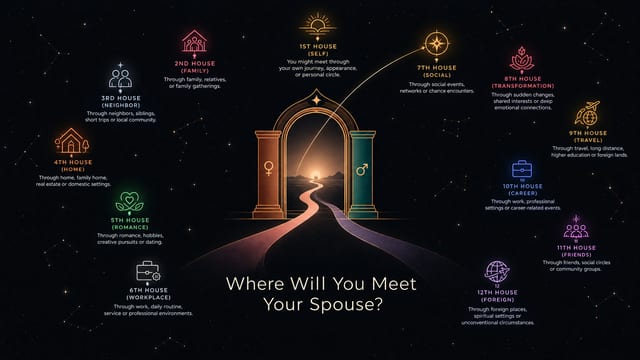
Where Will You Meet Your Spouse? The 7th House Lord in All 12 Houses
Where will you meet your future spouse? The placement of your 7th house lord holds the answer — from family gatherings, social media, and the workplace to temples, weddings, and long journeys. Here is what each of the 12 house placements means for your meeting.
11 Oct 2026
Marriage
Venus in the 12 Zodiac Signs: Love, Marriage & Relationship Meaning
Learn how your Venus sign reveals the past, present and future of your relationships using the Vedic trikona principle. Discover what the 5th and 9th signs from Venus say about love, marriage, karmic connections and your relationship's long-term destiny.
9 Jul 2026
Marriage
Rahu and Ketu in Navamsa: Your Spouse's Hidden Demands
Your Navamsa (D9) chart reveals far more than marriage timing—it shows what your spouse truly expects from you. Discover how every Rahu–Ketu house placement shapes relationship dynamics, hidden karmic lessons, and the practical changes that help your marriage thrive.
4 Jul 2026