
Signs of Divorce and Separation in Vedic Astrology
Published 1 July 2026 · By OrbitVeda Editorial · Updated 1 July 2026
Marriage is not a universal destiny. Among the billions of souls on this planet, some are born to marry early, some to marry late, and some not to marry at all. Astrology does not judge a life by whether it includes a wedding. It simply reveals the karmic blueprint that the soul chose before taking birth. When a person understands that a delay is not a denial and that a denial is often a redirection toward a higher purpose, the anxiety that surrounds the question of marriage begins to dissolve. This article explores the most fundamental astrological signatures of delayed marriage, the placement that indicates marriage may never happen, the combinations that invite infidelity, and the single most powerful indicator of actual divorce: the combustion of Venus by the Sun. Every insight is rooted in the basic language of houses, signs and degrees, the grammar that underpins every birth chart.
The Basic Houses That Govern Marriage
Before examining the specific combinations, it helps to recall what each house represents. The second house governs family, speech, family business and accumulated assets. The fourth house is the home, domestic peace, and the relationship with everyone under the same roof. The fifth house rules romance, creativity, children and education. The seventh house is the house of marriage, legal union and committed partnership. The ninth house governs long‑distance travel, world philosophy, religion and higher wisdom. The tenth house is the house of career and public standing. When planets influence the seventh house, they do not just affect the spouse. They affect the very architecture of the native’s capacity to form a lasting bond. A planet sitting in the seventh house, ruling the seventh house, or casting its aspect onto the seventh house will colour the entire marital experience, whether by delaying it, denying it, or testing it through infidelity and conflict.
Delay in Marriage: The Role of Saturn
Why Saturn Delays Rather Than Denies
Saturn is the planet of time, discipline and karmic backlog. When Saturn rules the seventh house, sits in the seventh house, or aspects the seventh house, marriage does not happen on the timeline that society expects. Saturn does not deny marriage. It delays it until the native has learned the lessons they were born to learn. For those with a Capricorn or Aquarius rising in the seventh house, which occurs for Cancer and Leo ascendants respectively, this Saturnine influence is automatic. The native may spend their twenties watching friends marry while their own relationships dissolve or never quite solidify. They may meet many soulmates, many deep connections, and each one will seem to be taken away just when permanence felt close.
The Karmic Curriculum Saturn Imposes
The reason is that Saturn carries a karmic curriculum. Before the native can receive the partner they need, they must undergo a series of emotional ups and downs that break the ego, humble the heart, and teach discernment. Those who try to marry before the age of thirty‑two or thirty‑five under this placement often find that the marriage ends in divorce, because the lessons were not yet fully absorbed. Saturn uses relationships as classrooms, and if the student tries to graduate early, the diploma is revoked. When Saturn finally does deliver the partner, the spouse tends to be mature, either by age or by the maturity of the mind. The bond may not be the most passionate, but it is stable, responsible and built on a foundation that the earlier years could never have supported.
When Jupiter Intervenes
There are mitigating factors. If Jupiter aspects the seventh house or its lord, the delay may be shortened and the marriage may happen earlier while still maintaining its integrity. Jupiter’s expansive and protective gaze can override Saturn’s restrictive timeline without cancelling the lessons entirely. The native may still experience significant relationship challenges, but the arrival of the spouse is accelerated. The core principle remains: Saturn in connection with the seventh house is not a curse. It is a cosmic timer set to go off only when the soul is ready.
When Marriage Is Not Meant to Be: Ketu in the Seventh House
The Soul That Has Already Completed Marriage
While Saturn delays, Ketu detaches. Ketu is the south node of the Moon, the repository of past life achievements and the planet of spiritual completion. When Ketu occupies the seventh house, the soul has already experienced marriage in a previous incarnation. It has known the joys and the burdens of partnership, and in this lifetime it simply does not crave the experience again. The desire to merge with another human being is replaced by a quiet, often unconscious, pull toward solitude. Ketu in the seventh house says, “I have done this before. I do not need to do it again.”
The Two Extremes of Ketu’s Expression
This placement can manifest in two very different ways. The native may become deeply spiritual, choosing a life of service, meditation, or renunciation, and genuinely not miss the companionship of a spouse. They may become like Mother Teresa, whose life was devoted to a higher calling that left no room for a conventional marriage. Alternatively, the native may swing to the opposite extreme, becoming a figure who collects romantic partners without ever committing to one. They may be like Hugh Hefner, surrounded by partners, yet fundamentally alone. Both paths are expressions of the same Ketu energy: the refusal to be bound by the traditional structure of marriage. The person who is surrounded by partners is still, in a spiritual sense, alone. The person who lives in an ashram has simply made that aloneness visible.
When Benefics Save the Marriage
Ketu in the seventh house does not always mean a lifetime of singledom. If Jupiter or Venus sits with Ketu or aspects it strongly, a marriage can still take place. However, the marriage will not be the most blessed union. The couple may argue constantly, like the old married pair that bickers from morning to night yet cannot imagine life without each other. The bond exists, but it is tested daily. Ketu ensures that the smooth, effortless companionship that some couples enjoy is not part of this lifetime’s design. The benefic aspect does not remove Ketu’s detachment; it merely prevents it from completely destroying the possibility of partnership.
Signs of Infidelity That Lead to Divorce
Rahu in the Seventh House: The Illusion of Endless Desire
The north node, Rahu, is the planet of illusion, insatiable desire and the hunger for what one does not have. When Rahu occupies the seventh house, it creates a powerful magnetic pull. The native attracts attention from the opposite sex with ease, and opportunities for secret liaisons appear unbidden. Rahu whispers that the native is a king or a queen who deserves every pleasure, and the seventh house, being the house of partnership, channels that desire directly into the realm of relationships. Unless a benefic planet aspects Rahu or sits with it, the native will likely give in to temptation. The end result, once discovered, is often a divorce.
Mars in the Seventh House: Passion That Turns Into War
Mars in the seventh house brings a different flavour of trouble. Mars is passionate, obsessive, and combative. It does not simply attract infidelity; it creates an environment where arguments are constant and the emotional temperature never drops. Either the native or the spouse will cheat, because Mars fuels the kind of intense energy that seeks release outside the marriage when it cannot find harmony within. The partner of a Mars‑in‑the‑seventh‑house native may be the one who strays, or the native themselves may be the one who cannot resist. In either case, the marriage is tested at its root. The passion that initially drew the couple together becomes the very force that tears them apart.
Rahu‑Moon and Rahu‑Venus Conjunctions
Beyond the house placements, certain planetary conjunctions also signal a heightened risk of cheating. When Rahu conjoins the Moon, the mind becomes restless, and emotional needs are never fully satisfied by one person. The native may constantly seek new emotional stimulation outside the marriage. When Rahu conjoins Venus, the desires of the heart become amplified to a point where fidelity feels like a cage. Venus is the planet of love, beauty and pleasure, and Rahu’s shadow makes the native feel that the love they have is never enough, that someone else will always offer more. These combinations do not make a person bad. They make a person hungry, and unless that hunger is channelled through a benefic aspect or a strong spiritual practice, it can destroy the most sacred of bonds.
The Actual Divorce Indicator: Sun‑Venus Combustion
What Is Combustion and Why It Matters
While Saturn delays and Ketu detaches, and while Rahu and Mars test fidelity, the single most consistent indicator of legal divorce is the combustion of Venus by the Sun. Venus is the karaka of marriage, love and harmony. The Sun is the hottest, brightest body in the solar system, and when a planet comes too close to the Sun, its positive qualities are evaporated. In astrological terms, a planet is considered combust when it falls within six degrees of the Sun, measured by longitude. At that proximity, the planet is still present, but its beneficial energy is severely weakened. It is as if Venus is standing too close to a fire: it is still visible, but its fragrance, its softness, and its capacity to nurture are all burning away.
The Paradox of Combust Venus
When Venus is combust the Sun, a tragic paradox unfolds. Venus calls for love and union, and the native genuinely desires a partner. But because the energy of Venus is being burned away, the very love that is sought arrives only to be destroyed. The marriage is welcomed with hope, and then it breaks. The native is not indifferent to marriage. They want it deeply, perhaps more than most. But the planetary energy required to sustain a union is being consumed even as the union is formed. This is why the divorce happens: not because love was absent, but because the love that was present could not survive the heat.
The Houses Where Combustion Is Most Dangerous
This combination is especially potent when the Sun and Venus occupy any of the following houses: the second, the fourth, the fifth, the seventh, the eighth or the ninth. The second house governs family and accumulated wealth, and a combustion here can tear apart the family structure. The fourth house governs domestic peace, and the burning of Venus can turn the home into a battlefield. The fifth house governs romance and children, and a combustion here can poison the creative and romantic expression of the marriage. The seventh house is the house of marriage itself, and a combust Venus here strikes directly at the heart of the union. The eighth house governs transformation and secrets, and the combustion can bring hidden affairs to light in a way that ends the marriage. The ninth house governs dharma and higher purpose, and when Venus burns here, the native may feel that the marriage is a violation of their spiritual path.
When the Marriage Is Saved Despite Combustion
There are exceptions that can save the marriage even when Venus is combust. If Jupiter aspects the combust Sun‑Venus pair, the guru’s protective gaze can neutralise the burning and hold the union together. Jupiter is the great benefic, and its wisdom and expansion can provide the shelter that Venus alone cannot. If the Sun and Venus are in the same sign but far apart in degrees, beyond the six‑degree combustion zone, the marriage may survive because Venus is hot but not destroyed. A Sun at five degrees Leo and a Venus at twenty‑five degrees Leo may share a house, but the distance preserves Venus’s integrity. The combustion must be tight, within that critical six‑degree range, and unaspected by a benefic, to deliver its full separating effect. It is worth noting that Venus and Mars together can also create obsessive passion that strains a marriage, but the Sun‑Venus combustion remains the textbook signature of divorce, the one combination that astrologers watch for when a client asks whether the union will survive.
Beyond Sun‑Sign Matching: The Need for Detailed Chart Analysis
The tragedy of modern relationships is that most people enter marriage based on superficial compatibility. They match sun signs, numerology numbers, or simply the chemistry of initial attraction, and they wonder why the union fails. The divorce rate in some countries now exceeds sixty percent, and a large portion of that heartbreak could be avoided if the detailed astrological chart were consulted before the vows were taken. Saturn’s delay, Ketu’s detachment, Rahu’s illusions, and the Sun’s burning of Venus are not visible in a newspaper horoscope. They require a careful reading of houses, signs, degrees and aspects. A chart that appears perfect on the surface can hide a combustion that will undo the marriage within years. A chart that seems afflicted by Ketu can be rescued by a single, powerful Jupiter aspect. The difference between a lifetime of harmony and a courtroom of bitterness is often hidden in the degrees that most people never check. This is why rushing into marriage without a proper astrological consultation is like signing a contract without reading the fine print. The fine print, in astrology, is written in the degrees, the aspects, and the combustion zones. The successful marriage is not the one that looks good on paper. It is the one where the hidden dangers have been identified, understood, and, where possible, remedied before the knot is tied.
Remedies and Spiritual Connection
Astrology is not fatalism. The combinations described in this article show tendencies, not sealed verdicts. Remedies exist, and they work, but they must be approached with the right understanding. Yagnas, homas and specific rituals can pacify the afflicted planets and soften the edges of a difficult transit or a challenging natal placement. Gemstones are also a part of the remedial tradition, but they should be treated as a last resort, not a first impulse, and only after thorough astrological consultation. The most powerful remedy, however, is far simpler and costs nothing. It is the genuine belief in a supreme power and the daily effort to connect with that source through prayer, meditation, or selfless service. When a person aligns themselves with the divine, the planets still operate, but their capacity to harm is dramatically reduced. The soul that trusts the higher plan can endure a delay with patience, can accept a denial with grace, and can transform even a combustion into a lesson rather than a tragedy. The planets can influence the events of a life, but they cannot touch the core of a soul that has surrendered to something greater than itself.
Conclusion
The stars do not determine whether you will be happy. They determine the raw material you are given to work with. Saturn in the seventh house gives you time to become the person who can sustain a marriage. Ketu in the seventh house gives you the freedom to pursue a purpose that partnership would have eclipsed. Rahu and Mars in the seventh house give you the challenge of mastering desire, of learning that more is not always better and that passion without peace is a fire that consumes its own fuel. And the combustion of Venus by the Sun gives you the opportunity to learn that love, when it is not built on a foundation of self‑awareness, can burn as easily as paper. If your chart carries one of these signatures, do not panic. Understand the energy, seek the remedy, and above all, trust that the same intelligence that placed the planets also placed the strength within you to walk your path with courage. The chart is not a cage. It is a map, and every map contains more than one route to the destination. The route you take is still, and always, your own choice.
Frequently Asked Questions
Does Saturn in the seventh house always mean a delayed marriage?+
Saturn in the seventh house, ruling the seventh house, or aspecting the seventh house almost always delays marriage until the native has matured emotionally. The delay is not a denial but a period of learning. If Jupiter aspects the combination, the marriage may still occur earlier than the mid‑thirties, but the native will still undergo significant relationship lessons before settling down.
Can a person with Ketu in the seventh house ever have a happy marriage?+
Ketu in the seventh house indicates that the soul has already experienced marriage in a past life and does not crave it now. If Jupiter or Venus aspects Ketu, a marriage can take place, but it will often involve constant bickering and a sense of emotional distance. The marriage survives, but it is not the effortless, romantic union that other placements can produce.
What is the difference between Rahu in the seventh house and Mars in the seventh house regarding infidelity?+
Rahu creates illusion and an insatiable desire for new experiences, leading the native to seek affairs because they feel entitled to them. Mars creates constant conflict and intense passion, which can lead either the native or the spouse to cheat as an outlet. Both placements increase the risk of infidelity significantly unless a benefic planet aspects the house.
Why does the Sun combusting Venus cause divorce?+
Venus is the significator of love and marriage. When Venus comes within six degrees of the Sun, its positive energy is burned away. The native still desires love, and a marriage does form, but the underlying energy is so weakened that the union breaks apart. This is most dangerous when the combustion occurs in the second, fourth, fifth, seventh, eighth or ninth houses.
Can remedies really prevent a divorce that is strongly indicated in the chart?+
Remedies can pacify planetary afflictions and soften the intensity of difficult combinations. Yagnas, homas, and genuine spiritual connection to a higher power can change the trajectory of a relationship. The chart shows tendencies, not an unchangeable fate, and conscious effort combined with sincere remedial practice can often save a marriage that astrology alone would predict to fail.
More Marriage Articles
Related guides on compatibility, timing, and interpretation.
Marriage
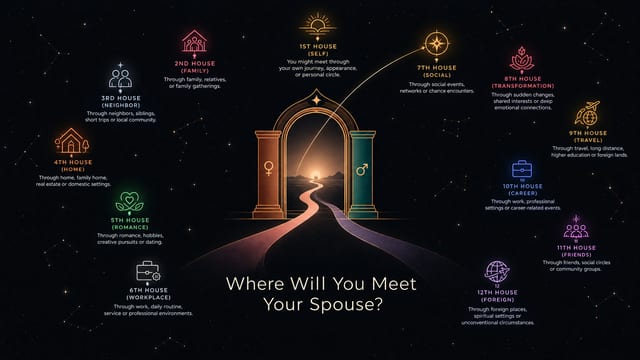
Where Will You Meet Your Spouse? The 7th House Lord in All 12 Houses
Where will you meet your future spouse? The placement of your 7th house lord holds the answer — from family gatherings, social media, and the workplace to temples, weddings, and long journeys. Here is what each of the 12 house placements means for your meeting.
11 Oct 2026
Marriage
Venus in the 12 Zodiac Signs: Love, Marriage & Relationship Meaning
Learn how your Venus sign reveals the past, present and future of your relationships using the Vedic trikona principle. Discover what the 5th and 9th signs from Venus say about love, marriage, karmic connections and your relationship's long-term destiny.
9 Jul 2026
Marriage
Rahu and Ketu in Navamsa: Your Spouse's Hidden Demands
Your Navamsa (D9) chart reveals far more than marriage timing—it shows what your spouse truly expects from you. Discover how every Rahu–Ketu house placement shapes relationship dynamics, hidden karmic lessons, and the practical changes that help your marriage thrive.
4 Jul 2026