
Venus in Every Nakshatra: Spouse Initials, Appearance & Meeting Place
Published 16 June 2026 · By OrbitVeda Editorial · Updated 16 June 2026
When we talk about relationships, we talk about Venus. But looking at Venus in a house, in a sign, or even in the Navamsa never gives us the depth that the nakshatras provide. Every nakshatra tells a story. This story reveals where you will meet your partner, what name letters influence your spouse, the deeper karmic connection that brings the two of you together, and what family patterns you must check to know whether the relationship will sustain. This article covers Venus in all twenty‑seven nakshatras, grouped by their planetary rulers, so you can understand exactly how your Venus shapes your entire relationship dimension.
Venus in Ketu’s Nakshatras: Ashwini, Magha and Moola
Venus in Ashwini Nakshatra
Ashwini is the nakshatra of the healer. Its deities are the Ashwini Kumaras and its lord is Ketu. The karmic story connects to Rishi Dadhichi, whose head surgery was performed by the Ashwini Kumaras, and to Rishi Chyavana, whose eyes were restored. This tells us that if your Venus is in Ashwini, something significant will be seen on your spouse’s head or eyes. There could be a birthmark on the face, a cut, a mole, or some unique feature. If this nakshatra is afflicted, your partner may suffer from migraines, headaches, or may even require surgery in those areas. If it is strong, you may marry a person with blue eyes or royal features. Meeting circumstances are always marked by speed and movement. You could meet at a gym, in a subway, on a train, or while taking a flight. Travel is the key activator of this nakshatra. If you have been struggling to find a relationship, simply plan a trip. The partner often enters your life when you feel completely broken, exhausted and at a low point. Your spouse acts like a healer who arrives to restore your happiness. The negative side of Ashwini is instability. Like a horse, the relationship can be impatient and restless. Commitment may be fast, but staying power becomes a challenge. If you want to check whether your Venus in Ashwini is working well, ask your family if after your birth any relationship turmoil or disturbance arose between your parents. If yes, then Venus and Ketu are afflicting each other. The remedy is to serve at an ashram, an old age home, or to perform spiritual service to an elderly person. Name letters for Ashwini are C, A, Y, O. This nakshatra indirectly influences Purva Phalguni, Jyeshtha and Rohini, so look for planets in those nakshatras in your own and your partner’s chart. Activation ages are around 24 and 42, and the relationship is most vulnerable in the first six months to six years.
Venus in Magha Nakshatra
Magha is the royal nakshatra of the ancestors. Its deity is the Pitris and its lord is Ketu. If your Venus sits in Magha, you will meet your partner in places of power. It could be an IAS chamber, a secretariat, a government building, or any setting where authority is present. The seeds of this relationship were sown in a past life, and your ancestors play a direct role in bringing this person to you. The partner may carry physical or behavioral traits that are already present in your family lineage. The positive aspect of Magha is that your status in society grows after marriage. The negative side is ego. In this nakshatra, either the wife will dominate the husband or the husband will dominate the wife. Balance is hard to find. The partner may also have a royal, commanding presence. To check if Venus is performing well, see if after your birth any disputes arose in the family, especially involving the father and grandfather. If there was a death of a family member at an early age, or a downfall of the father, then ancestral lines are blocking the marriage. Name letters for Magha are M and K, with H also included. It indirectly influences Bharani, Ashlesha and Shravana. DNA coding is everything in Magha, so if your partner’s family has a hereditary health issue, it will likely appear in your partner too. Activation ages are earlier than most; marriage can happen early unless pitra dosha is present.
Venus in Moola Nakshatra
Moola is the nakshatra of deep transformation. Its deity is Nirriti and its lord is Ketu. This is a gandmool nakshatra, which makes people nervous, but Moola is actually the most powerful source of energy in the entire nakshatra belt. When Venus is in Moola, your relationship will always walk with a shadow of crisis. You will meet your partner at a time when you are under immense pressure, facing a problem, or going through a challenging phase. This relationship has the capacity to take you from zero to hero, or from hero to zero. Transformation is maximum, and there is no middle ground. If the relationship goes well, it can be the most positively transformative force in your life. If it fails, the person may completely give up on the idea of marriage after one or two failed connections. To check the health of this placement, look at the relationship between your father and grandfather after your birth. If there was distress or negativity between them, then Venus is not performing well. The best remedy is to donate something every Saturday. Black sesame or any Saturday donation is powerful. Moola influences Punarvasu, Revati and Ardra. Name letters are N, T, D and B. Activation often occurs when you are in the middle of leaving something behind, including running away from a job or a situation.
Venus in Venus’s Own Nakshatras: Bharani, Purva Phalguni and Purva Ashadha
Venus in Bharani Nakshatra
Bharani is the nakshatra of transformation through pain. It can be described as the “pain to gain” nakshatra. Its deity is Yama and its lord is Venus. When Venus sits in its own nakshatra here, the journey of the relationship is from suffering to happiness. The karmic layer is that you or your partner deeply seek protection. One of you wants to be protected, and the other provides that shelter. This nakshatra reflects the womb of a mother, so security is the core theme. Meeting circumstances are often when you are running away from something. You may be exhausted from a competitive exam, fleeing from a toxic job, or escaping a situation, and that is when you meet your partner. The negative side is limitation. Just as a baby in the womb cannot move freely, one person in the relationship will always feel restricted and controlled by the other. The controller will say, “I am the one who decides.” The remedy is to serve your ancestors, because Bharani is deeply connected to pitra energy. Something very significant happened with your partner’s mother around six to seven years after your partner’s birth, or even before the partner’s birth involving a sibling. Name letters are L and N. This nakshatra influences Magha, Anuradha and Krittika.
Venus in Purva Phalguni Nakshatra
Purva Phalguni is the party nakshatra. Its deity is Bhaga and its lord is Venus. If Venus is here, your meeting circumstances are full of enjoyment. You could meet at a party, a club, while on holiday, trekking, or during any kind of leisure activity. The partner is attractive, and looks are highly prioritised. The deity Bhaga once lost his eyesight, so this nakshatra carries the energy of becoming blind in love. You may ignore everything else, sacrifice everything, and focus entirely on the partner. The partner’s eyes will be the most striking feature. The negative side is that the relationship can be destroyed by excessive partying, friend circles, impulsive behavior, or an overly easygoing attitude. This nakshatra influences Ashwini, Pushya and Abhijit. Name letters are T, A, J and O. The core lesson is not to let enjoyment make you completely blind to the reality of the relationship.
Venus in Purva Ashadha Nakshatra
Purva Ashadha is the invincible nakshatra. Its deity is Apah (water) and its lord is Venus. Just as water cannot be bound, this nakshatra cannot be controlled. The symbol is the tusk of an elephant, representing unshakeable strength. If your Venus is here, the relationship can make you and your partner a power couple. This is the nakshatra of influencers, those who dominate social media together. After marriage, the power and positive transformation are maximum. Meeting circumstances are similar to Purva Phalguni, involving enjoyment, but expanded. You could meet while trekking, on a grand holiday, or at any place where you feel a sense of achievement. The negative side is stubbornness. The partner may be fixed in their ways. This nakshatra is also deeply connected to the bed, so it speaks about the backbone and the teeth. Ask your partner if they had any childhood accident that caused a tooth gap or a spinal issue. Until the age of 32, life in the relationship remains fluctuating; stability comes after. There is also a tendency to forget one’s own family and become completely devoted to the in‑laws. Name letters are B, P, K and G. It influences Mrigashira, Uttara Phalguni and Purva Bhadrapada.
Venus in Sun’s Nakshatras: Krittika, Uttara Phalguni and Uttara Ashadha
Venus in Krittika Nakshatra
Krittika is the sharp blade nakshatra. Its deity is Agni and its lord is the Sun. When Venus is in Krittika, the relationship has a sharp, cutting energy. Meeting circumstances occur in competitive environments where intellect is tested. This could be an educational institute, a college, a school, an office, or a team project where competition runs day and night. Restaurants and kitchens are also possible meeting places. The deity Agni brings purity, energy and enthusiasm to the partner. Your spouse will be energetic, upbeat, and always ready to go. The negative side comes from a curse. Agni was cursed by the seven sages, so the number seven becomes very important in the relationship. The seventh month, the seventh year, or a pattern of attraction to a third person can appear. The partner can be sharp‑tongued, cutting others off in conversation and not letting anyone else speak. The remedy is to feed people. Donating food pacifies Krittika. Name letters are A and T. It influences Shravana, Bharani and Vishakha. Also, check if after the partner’s birth, the mother was overloaded with pressure or had health issues that caused the child to be raised by others or by the mother’s siblings.
Venus in Uttara Phalguni Nakshatra
Uttara Phalguni is the contract nakshatra. Its deity is Aryaman, the divine matchmaker who played a key role in the marriage of Lord Shiva and Mother Parvati. When Venus sits in a Sun nakshatra, especially this one, the relationship carries a soul connection. You may feel that you have known this person across many lifetimes. This nakshatra strongly favors arranged marriages. Building the relationship is easy, but converting it into a committed marriage is where the real challenge lies. The positive side is that society gives you value and your status grows. The dark side is that warmth in the relationship may be lacking because Sun’s nakshatras are about duty, not romantic love. Your partner may become detached, leaving everything to serve society or to help others. Name letters for Uttara Phalguni are B, P, K and G. It influences Mrigashira, Uttara Phalguni and Purva Bhadrapada.
Venus in Uttara Ashadha Nakshatra
Uttara Ashadha is the nakshatra of final victory. Its deity is the Vishwadevas and its lord is the Sun. When Venus is here, you are looking for a relationship that feels like the ultimate achievement. You may experience delays and denials because you are searching for something that represents final victory. You may meet your partner at a place where competition has peaked and victory is about to be yours. It could be after cracking a competitive exam, completing a major team project, or achieving a lifelong goal. The negative side is that work pressure can create physical separation. You may see couples where one person is in Delhi and the other in Mumbai. The relationship demands complete devotion; after marriage, your partner may become your everything, and other family ties may feel secondary. For a male native, this nakshatra gives a very supportive wife. For a female, it can bring work pressure and separation tendencies. Name letters are B, P, K and G. It influences Mrigashira, Uttara Phalguni and Purva Bhadrapada.
Venus in Moon’s Nakshatras: Rohini, Hasta and Shravana
Venus in Rohini Nakshatra
Rohini is the most magnetic nakshatra. Its deity is Prajapati and its lord is the Moon. Venus in Rohini gives a spouse who is always attractive, fair, charming, and magnetic. The meeting circumstances are at beautiful places. It could be a showroom, a positive environment, or through social media. Rohini is about ascending, riding something, so car showrooms or platforms where you sit and discuss things can trigger a connection. Once you meet, the grip of this nakshatra is so deep that you can spend the entire day lost in thoughts of that person. The negative side is jealousy. The Moon was cursed in Rohini, so other people become extremely jealous of your relationship. Small things make people envious. Tensions can arise because of the mother‑in‑law. If you are a female with Venus in Rohini, you should look for a partner who is older or younger than you, not the same age. The relationship is most stable for about nine to ten months, after which disturbances can arise. Name letters are V, R, O and U. It influences Ashwini and Swati.
Venus in Hasta Nakshatra
Hasta is the skillful nakshatra. Its deity is Savitar and its lord is the Moon. When Venus sits in Hasta, skills dominate the relationship. Your partner will have more than one skill. Meeting circumstances are at places where a skillful activity is happening. It could be an art gallery, a promotion event, or any place where creativity and sacrifice of one’s craft are on display. The partner can be a healer, an astrologer, a teacher, a doctor, a poet, a writer, a director, or an editor. The golden hands of Savitar represent the unique ability to create. The negative side is that information is hidden. The hands of Savitar were burned because of hidden information, so in this nakshatra, your partner may hide things from you. The best remedy is food donation on Mondays. Hasta activates earlier than many nakshatras, so you may find a relationship at age 22 or 24. Name letters are T, H, R, A, Y and L. It influences Uttara Bhadrapada, Ardra and Purva Ashadha.
Venus in Shravana Nakshatra
Shravana is the nakshatra of listening. Its deity is Lord Vishnu in the Vamana avatar and its lord is the Moon. If Venus is here, the partner is a great listener. The ears and the head area are especially significant. If the nakshatra is afflicted, your partner may suffer from migraines or headaches. If it is strong, the face is beautifully crafted. The partner may love music, intellectual pursuits, reading spiritual books, and deep contemplation. Meeting circumstances are in places of intellect. A library, a college, a hostel, a music concert, or even YouTube and social media platforms where one listens deeply. The negative side is manipulation. Moon’s nakshatras are inherently manipulative. Your partner may listen to you, learn from you, and later use your own words against you. The deity Vamana took three steps to measure the universe, so the number three is very significant in the relationship. Also observe the partner’s walk; there may be something unique about their legs and feet. Name letters are K and M. It influences Krittika, Magha and Dhanishta.
Venus in Mars’s Nakshatras: Mrigashira, Chitra and Dhanishta
Venus in Mrigashira Nakshatra
Mrigashira is the nakshatra of searching. Its deity is Soma and its lord is Mars. When Venus sits here, the relationship is always in a state of searching. The karmic story links to Lord Rama’s search for Mother Sita. You are constantly looking for new options, and the partner is someone who takes the relationship very seriously but also never fully finalises one person. The meeting circumstances happen in unexpected places where nobody thought a connection could form. You might be traveling to a new city, looking for a new job, or searching for a new option in life, and the relationship appears. The negative side is the eternal thirst. Like the mirage of a deer, the search never ends, and this can lead to multiple relationships or an inability to settle. To check the health of this placement, ask if after your birth, the relationship between siblings became tense, or if the father’s siblings had marital problems. If yes, your own relationship will carry similar tensions. Name letters are A, L, K and P. It influences Uttara Ashadha, Revati and Chitra.
Venus in Chitra Nakshatra
Chitra is the nakshatra of photography, beauty and spotlight. Its deity is Vishwakarma and its lord is Mars. Venus in Chitra will never compromise on looks. The partner must be beautiful. Meeting circumstances are at places that are the limelight of your city. A famous hotel, a restaurant, a family function where photography and videography are the focus, or even through Instagram and movie making. The partner may have a habit of speaking without thinking, a foot‑in‑mouth disease. They say things impulsively without considering the consequences. The negative side is that the father’s relationship with his daughter, or the mother’s relationship with her son, may not be smooth in the partner’s family. This nakshatra influences Purva Bhadrapada, Mrigashira and Moola. Name letters are P, K, T and N. The remedy lies in guarding your speech and not letting impulsiveness destroy the relationship.
Venus in Dhanishta Nakshatra
Dhanishta is the nakshatra of wealth and status. Its deity is the Vasus and its lord is Mars. Venus here demands that the relationship bring a massive jump in status and wealth. Meeting circumstances are at places of luxury. A bank, a lavish restaurant, a movie theater, or any place that elevates your status. Your partner arrives in your life to boost your financial and social standing. In this nakshatra, one person will always dominate. Either you will control the relationship, or your partner will. To check if the nakshatra is working well, ask your family if after your birth, the siblings or the father’s side experienced a major financial gain or loss. If a big gain happened, the relationship will bring prosperity at the ages of 28 or 32. Name letters are G and D. It influences Vishakha, Shravana and Ashlesha.
Venus in Rahu’s Nakshatras: Ardra, Swati and Shatabhisha
Venus in Ardra Nakshatra
Ardra is the nakshatra of tears. Its deity is Rudra and its lord is Rahu. Venus in Ardra makes the relationship intense and unconventional. Society will always ask questions about your relationship status, no matter how well things are going. This nakshatra carries the energy of a teardrop and a Rudraksha. The partner may appear aggressive from the outside but is very soft inside. They may have faced significant family toxicity or identity crises. Meeting circumstances happen when your life is in turmoil. You are changing homes, things are chaotic, nothing is normal. That is the moment the relationship manifests. The partner may have tattoos, piercings, or a unique body style. They often carry a feeling of not belonging. Name letters are V, C, H, L, T and R. It influences Purva Ashadha, Uttara Bhadrapada and Hasta.
Venus in Swati Nakshatra
Swati is the nakshatra of isolation. Its deity is Vayu and its lord is Rahu. The symbol is a single plant standing against the wind. Venus in Swati makes you feel completely alone in your relationship, fighting against society to sustain your bond. The partner carries a deep sense of emptiness and isolation. They may have struggled their entire life to build their identity, only to feel crushed by the world. Meeting circumstances occur when you accept your aloneness and decide to better your life. You may join an education camp or a meditation retreat with the thought, “I am alone, I am tired of being alone.” There you meet your partner. The teeth and bones are the most prominent physical features. Name letters are R, O, Ri and V. It influences Shatabhisha, Rohini and Jyeshtha. The remedy is to consciously build your identity without expecting the world to validate it.
Venus in Shatabhisha Nakshatra
Shatabhisha is the nakshatra of a hundred eyes. Its deity is Varuna and its lord is Rahu. Venus here makes you focus on the smallest details of your relationship. You invest eighty percent of your life into the relationship and very little into other areas. The partner may be secretive and hard to read. Meeting circumstances are at hospitals, clinics, healing centers, meditation centers, or near the ocean. Beaches and solitary places also activate this nakshatra. To check the health of this placement, ask if after your birth, there was a financial loss or the loss of a person due to health issues. If yes, the relationship will carry tension. Name letters are R, S, O and H. It influences Swati and Pushya.
Venus in Jupiter’s Nakshatras: Punarvasu, Vishakha and Purva Bhadrapada
Venus in Punarvasu Nakshatra
Punarvasu means to settle again. Its deity is Aditi and its lord is Jupiter. Venus in Punarvasu indicates that a first relationship will face trouble, but the second one will work. The meeting circumstances are at reunions, get‑togethers, renovation events, or places where people are reconnecting. The partner may have a younger sibling who is very supportive. The positive side is the power of renewal. If one problem arises, the relationship gets a second chance. The negative side is that a storm or destruction always comes once before things settle. There is an underlying insecurity. The remedy is to plant a bamboo tree or a peepal tree in the northeast of your home. Name letters associated with this nakshatra are K, D, M and D. It influences Moola, Purva Bhadrapada and Uttara Phalguni.
Venus in Vishakha Nakshatra
Vishakha means two branches. Its deities are Indra and Agni, and its lord is Jupiter. Venus in Vishakha places you in a dilemma. Two paths exist, and you must choose one. Meeting circumstances are in competitive environments where one person wins and another loses. It could be an airport boarding queue, an office project where someone is fired, or any setting with a clear winner and loser. The partner is intellectual but never fully sure about the relationship. There is a constant fear of the mind wandering or of getting involved in multiple connections. Name letters are Th and A. It influences Dhanishta, Krittika and Anuradha. The duality of this nakshatra demands that you make a clear, conscious choice rather than floating between options.
Venus in Purva Bhadrapada Nakshatra
Purva Bhadrapada is the nakshatra of the double face. Its deity is Ajaikapada and its lord is Jupiter. Venus here brings duality into the relationship. Meeting circumstances often occur in hidden or secretive settings, such as a secret meeting hall, a tantric monastery, a cremation ground, a spiritual retreat, or when you are travelling under a hidden pretext. The partner may have two distinct sides to their personality. The negative side is that information is hidden and a dark side exists. The partner may be deeply spiritual but also keep something concealed. You can check this placement by seeing if after your birth, there was a secret or hidden issue within the family, especially involving spiritual or occult practices. Name letters for this nakshatra are G, Kh, D and K. It influences Chitra, Uttara Ashadha and Punarvasu. The relationship asks you to look beyond the surface and accept the hidden dimensions of your partner.
Venus in Saturn’s Nakshatras: Pushya, Anuradha and Uttara Bhadrapada
Venus in Pushya Nakshatra
Pushya is the nakshatra of nourishment. Its deity is Brihaspati and its lord is Saturn. Venus in Pushya means the relationship carries divine support. Even if fifty other yogas in the chart say marriage will not happen, Pushya can override them. Meeting circumstances are at temples, kitchens, schools, educational campuses, or during spiritual travel. Expansion is the key, so you may meet your partner within sixty to one hundred kilometers of your city. The negative side is that a third person can bring betrayal. Pushya does not like a third party involved. Keep friends and extended family out of the core of the relationship. Name letters for Pushya are H, S and O. It influences Jyeshtha, Shatabhisha and Purva Phalguni.
Venus in Anuradha Nakshatra
Anuradha is the nakshatra of devotion. Its deity is Mitra and its lord is Saturn. Venus here makes the relationship deeply devotional. Meeting circumstances involve foreign lands, friends, or social media. You could meet through a matrimonial site or through a friend’s introduction. The partner radiates loyalty and friendship. The challenge is that Saturn always teaches a lesson. In Anuradha, the lesson is distance from family. To sustain the relationship, you may need to live away from your birthplace and maintain some distance from relatives. Neighbours and friends can also become a source of disturbance. Name letters are N, L and H. It influences Ashlesha, Vishakha and Bharani.
Venus in Uttara Bhadrapada Nakshatra
Uttara Bhadrapada is the nakshatra of the deep ocean. Its deity is Ahirbudhnya and its lord is Saturn. Venus here means the relationship is calm on the surface but incredibly deep underneath. Meeting circumstances are near water, swimming pools, an underwater restaurant, a meditation center, or any place that feels quiet but holds hidden power. You may meet your partner when their life suddenly transforms, a storm hits their calm world, and you arrive as a divine protector. The karmic connection is that you and your partner have been seeking each other across lifetimes but only now unite. Name letters are S, A, J, C, L, R and V. It influences Hasta, Purva Ashadha and Ardra.
Venus in Mercury’s Nakshatras: Ashlesha, Jyeshtha and Revati
Venus in Ashlesha Nakshatra
Ashlesha is the serpent nakshatra. Its deity is the Sarpa and its lord is Mercury. Venus in Ashlesha gives a relationship full of magnetic grip. Meeting circumstances are hidden and secretive. You may hide the relationship from your family while meeting your partner. The partner carries a serpentine energy, with a strong, magnetic charm and a powerful hold over you. The eyes and the walk are especially captivating. The negative side is that once friends or family get involved, the trust can shatter completely. The relationship can become polluted by outside influences. To check the health of this placement, look at your maternal aunt’s (mausi’s) marriage. If it is disturbed or broken, your own relationship will reflect similar challenges. The remedy is to worship Lord Shiva on Nag Panchami, visit the Somnath Jyotirlinga, and donate food at a Nath temple. Name letters are D and G. It influences Anuradha, Dhanishta and Magha.
Venus in Jyeshtha Nakshatra
Jyeshtha means the eldest, the greatest. Its deity is Indra and its lord is Mercury. Venus here makes the relationship revolve around power and authority. Meeting circumstances are at powerful places: a government building, a five‑star hotel, a lavish setting where you feel like the owner of the moment. The partner carries a commanding presence and expects to be treated as the most important person. The negative side, especially for a female native, is struggle with in‑laws. The relationship can bring wealth and status, but domestic peace may be challenged. Name letters are Ri, Ya, A, H and Ch. It influences Pushya, Swati and Ashwini.
Venus in Revati Nakshatra
Revati is the nakshatra of complete devotion. Its deity is Pushan and its lord is Mercury. Venus in Revati demands total surrender in the relationship. Meeting circumstances occur through a guide, a philosopher, a teacher, a best friend, or a travel company that helps you. The partner is nourishing, protective, and expects nothing less than full devotion in return. After marriage, blood relationships may fade in importance because the partner becomes your entire world. The possessiveness is extreme. Name letters are D, B, L and A. It influences Uttara Phalguni, Moola and Mrigashira. If you can offer the complete devotion this nakshatra demands, it becomes one of the most fulfilling placements for Venus.
Conclusion
Your Venus nakshatra is a map to your partner’s face, the place you will meet, and the karmic story that binds you. Use the name letters to recognise them. Check the family links after your birth to see if the placement is working for or against you. And remember that every nakshatra also influences three others, so the full picture of your marriage lies in studying those connections too.
More Marriage Articles
Related guides on compatibility, timing, and interpretation.
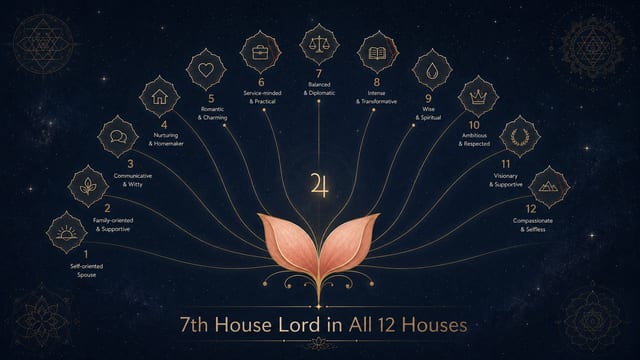
Marriage
7th House Lord in All 12 Houses: Marriage Timing, Spouse Traits & Delays
The placement of the 7th house lord is one of the most important indicators of marriage in Vedic astrology. It can reveal your likely marriage timing, spouse personality, relationship dynamics, and the karmic lessons you are meant to experience through partnership. This guide explains the effects of the 7th house lord in all 12 houses, including key marriage ages, spouse traits, and factors that may delay or strengthen marriage.
15 Jun 2026
Marriage
How to Check Happiness in Marriage Through the Fourth House of the D9 Navamsa
The fourth house of the D9 Navamsa chart is one of the most important indicators of marital happiness. This guide explains how every planet in the fourth house influences emotional fulfillment, romance, communication, intimacy, support, and long-term satisfaction in marriage. It also covers sign placements, planetary aspects, and how to interpret an empty fourth house.
8 Jun 2026

Marriage
Marriage Denial in Astrology: A Complete Integration of Parashari and Bhrigu Nandi Nadi Rules
Can a birth chart truly deny marriage? This guide unites Nadi and Parashari rules to reveal the structural conditions that make marriage nearly impossible.
19 May 2026