
Gyanesh Kumar Kundli Analysis: Vimshottari, Chara, and Yogini Dasha Predictions
Published 20 October 2026 · By OrbitVeda Editorial · Updated 20 October 2026
Gyanesh Kumar, the Chief Election Commissioner of India, was born in Agra on January 27, 1964, at 1:44 in the morning, and his chart offers a textbook study in the techniques used to verify a high position and to read the dashas that are running at any given moment. This article is an astrological study rather than a political commentary, because the purpose here is to examine the principles, the yoga formations, and the dasha systems of Vimshottari, Chara Dasha, and Yogini Dasha that describe the present period. The method follows a fixed sequence, the biological facts of the life are first verified against the chart, and only then are the running dashas read, with the strongest weight placed on the Yogini and Chara Dasha because they remain accurate even when a birth time carries a small margin of error, while the Vimshottari is used for confirmation.
The Birth Chart and Its High Position
The first question asked of any chart is whether it shows the kind of high position that the person actually holds, and here the verification begins with the rule of the night birth. Gyanesh Kumar was born at night, and in a night birth the invisible portion of the chart, the half that runs from the ascendant up to the seventh house, is examined to see how many planets it holds. This rule rests on the idea that the invisible half of the sky, the portion below the horizon, is where the deeper and more private strength of a chart resides, and when a person born at night carries the weight of their planets there, that hidden strength is what lifts them to prominence. In this chart almost every planet sits in that invisible half, with only the Moon and Rahu placed in the visible portion, and at night a chart that carries most of its planets, including Venus, in the invisible half is considered an auspicious sign, one that points toward a position of elevation.
| Kundli Birth Chart | D9 Chart |
|---|---|
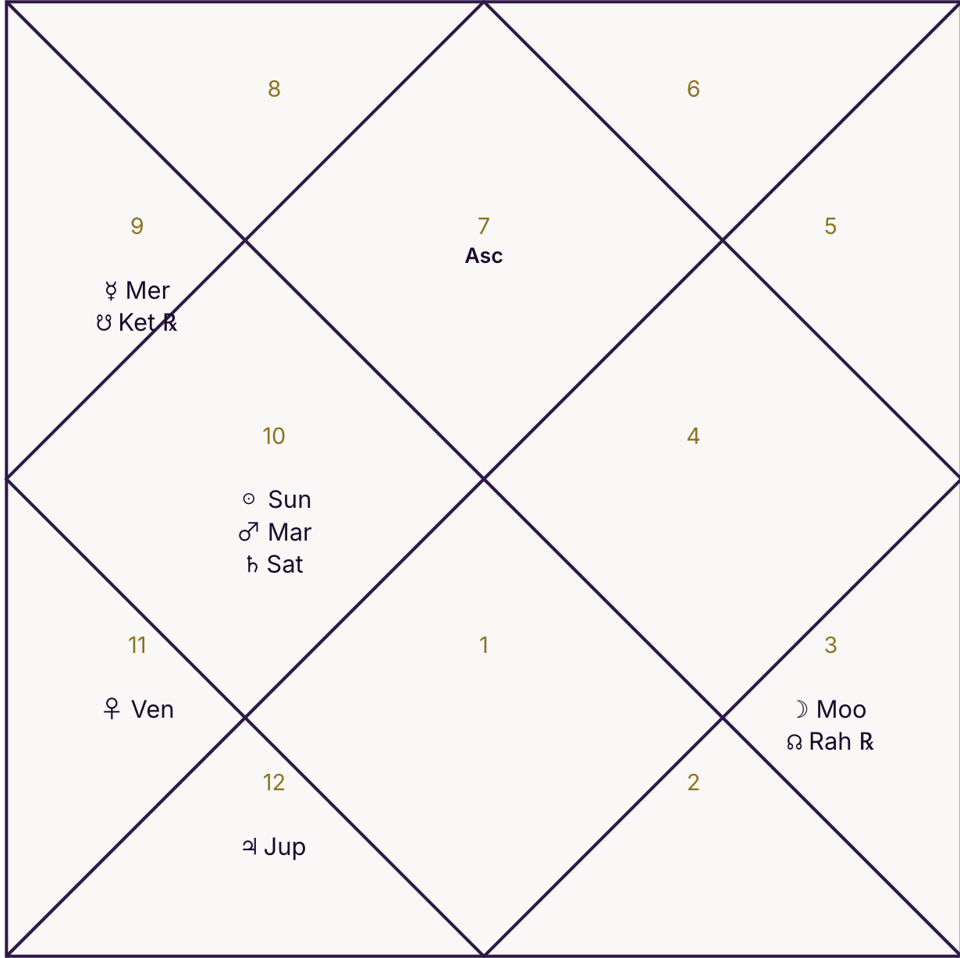 |  |
| The second indicator is found in the fourth house, where three malefic planets sit together, and this is a principle that has been taught before, that when three malefics occupy a house, the house eleven positions away from them becomes extremely strong. The logic is that three malefics gathered in one house produce an intense focus of energy, and the house eleven positions away from that gathering receives the full force of that focus. From the fourth house, the eleventh position is the second house, and the second house is the house of family and of speech, so this placement points to a strong and distinguished family, and the confirmation is found in the facts of the life, because Gyanesh Kumar was born into a highly respected family that counts twenty eight doctors among its members, along with three IAS officers, one IRS officer, and one IPS officer. |
The third indicator is a Raja Yoga formed by the Moon and Mercury, who are respectively the lords of the ninth house and the tenth house. When the lords of the ninth and tenth houses come together in mutual relationship, fortune and career are bound into a single stream, and this is one of the most reliable yogas of elevation and authority in the chart, a sign that the person is meant to hold a position of command. The Rahu and Ketu axis is also drawn into this Raja Yoga, so the nodes deliver the results of the yoga as well, and this establishes the kendra trikona relationship that supports a high position. The only note of caution in this foundation is Ketu sitting in the third house, which indicates some trouble connected to the third house of effort and of courage, but this is a secondary detail within an otherwise elevated chart.
Vimshottari Dasha: The Ketu Mahadasha
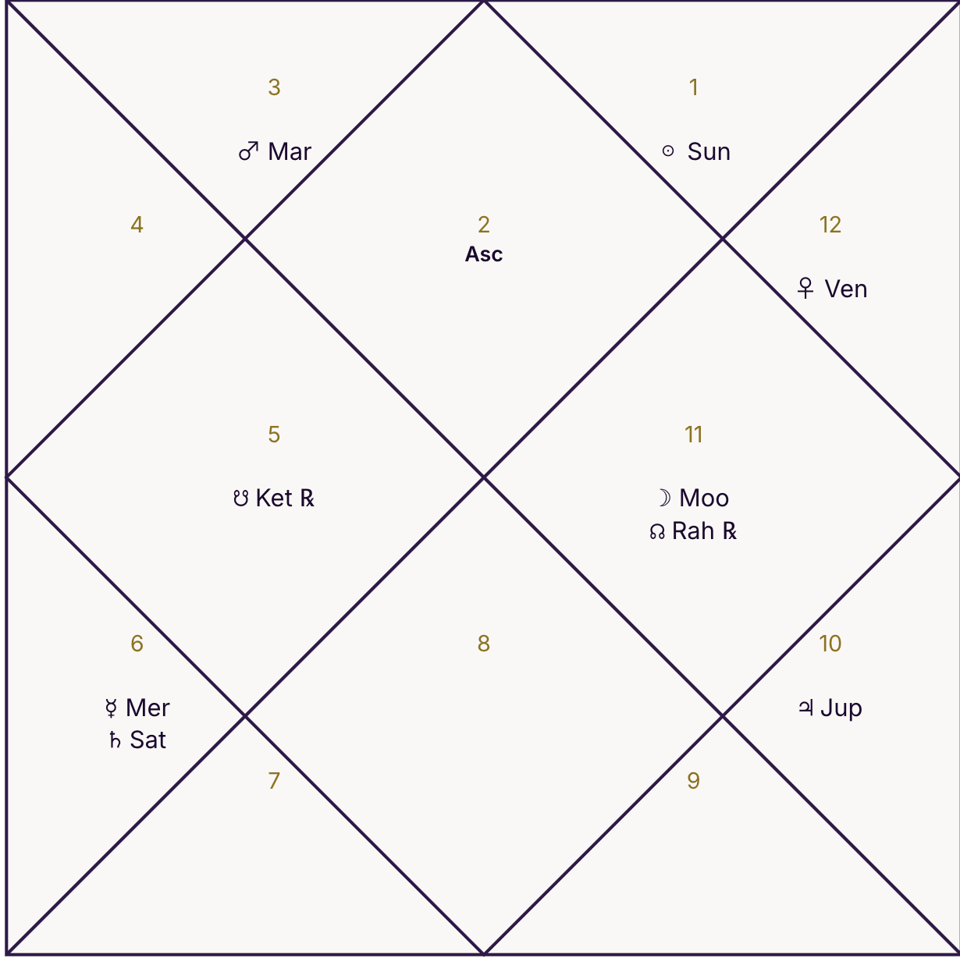
The present period is read first through the Vimshottari Dasha, which runs from July 3, 2026 to November 29, 2026, and this is read through the Chakra D3, the Drekkana, which is the chart of karma phal, the fruit of past actions. The Chakra D3 is read on the principle that the fruit of past actions is delivered through the sixth, eighth, and twelfth houses, so when the running planet in a dasha connects to the lords of those houses, the period delivers difficulty, while a connection to benefic or unafflicted planets delivers ease. In the Chakra D3, Ketu sits in the third house, and the lord of that third house is Mars, which is placed with Saturn, who is both the ascendant lord and the twelfth house lord, so the connection to the twelfth house is established through Mars, and this is what brings the period of strain.
Before the Ketu Mahadasha, the Moon Antardasha was running, and it was in the days just before July that the mental tension began, because the Moon carries the mind. The Ketu period itself runs from July 3 to November 29, 2026, and after November 29 the Antardasha of Rahu arrives, and because Rahu has no connection to the sixth, eighth, or twelfth houses and is aspected only by Jupiter, who is not a trik lord, the position is expected to improve from that point onward.
The Birth Chart Dasha Reading
The same period is confirmed from the birth chart itself, where Ketu again sits in the third house while Mars sits in the fourth house in its sign of exaltation, accompanied by Saturn and the Sun. Mars in this chart is a maraka, because it rules both the second and the seventh houses, and a maraka is a planet that rules the second or the seventh house, the houses connected to the ending of life, so a maraka period is always a time of caution even when the maraka is otherwise well placed. A maraka period combined with the involvement of a trik lord is understood to be a difficult one, and the one mitigating factor is that Mars receives the support of Saturn, who is a Raja Yoga karaka, but even with this support the reading remains consistent, because a maraka dasha touched by a trik connection is never a comfortable period, and this aligns with what the Vimshottari and the Chakra D3 have already shown.
Chara Dasha: Leo with the Pisces Antardasha
The Chara Dasha offers a further confirmation, and here the Leo Mahadasha with the Pisces Antardasha runs from July 27, 2026 to February 25, 2027. Leo is examined first, and no planet sits in Leo, while the Sun, the Moon, Mars, and Saturn aspect it from the sixth house, which is not a supporting combination. Pisces is then examined, and Jupiter sits in Pisces as the Amatya Karaka, while the Moon, who is the Jnati Karaka, casts its aspect upon Pisces, and the Rahu and Ketu axis also sends its aspect, along with the aspect of the twelfth house lord. The Jnati Karaka is the karaka of the sixth house matters, of obstacles and of adversaries, while the Amatya Karaka is the karaka of career and of authority, and the presence of both in the running antardasha describes a period in which professional pressure and obstacles rise together. So long as this Pisces Antardasha within the Leo Mahadasha continues, the difficulty is indicated, and it continues until February 25, 2027, which again points to the end of the year as the moment when the pressure begins to lift.
Yogini Dasha: Siddha with the Ulka Antardasha
The Yogini Dasha is read next, and here the Siddha Dasha is running with the Ulka Antardasha from May 6, 2027 to July 6, 2027. In this reading the progressed lagna becomes Sagittarius, because the nakshatra involved is Purva Ashadha, which belongs to Venus, and the progressed lagna in the Yogini system is fixed by the nakshatra of the running period, so the entire reading is anchored in Sagittarius, where Venus is not a favourable planet. In the Ulka Antardasha, Saturn is the running planet, and when Sagittarius is taken as the lagna, Saturn sits in the second house in its own sign, and Saturn is the lord of both the second and the third houses. When the lord of the third house moves into the second house, which is twelve places from the third, it brings the period of settling one’s karma, the examination of accumulated debt, and so this dasha is understood as the test of karma that continues until July 6, 2027. This period does not bring the harshest suffering, because Saturn is with the trikona lords, but it does keep the pressure of that karmic examination in place until it concludes.
Conclusion
Reading Gyanesh Kumar’s chart through the three dasha systems produces a consistent and clear timeline. The birth chart itself is verified as a chart of high position, with the night birth rule placing most planets in the invisible half, the three malefics in the fourth house strengthening the family, and the Moon and Mercury forming a Raja Yoga of fortune and career. The running dashas, however, describe a period of mental tension that began around June and July of 2026, because the Vimshottari Ketu period connects to the twelfth house through Mars, the Chara Dasha carries the aspect of the Jnati Karaka and the nodes upon Pisces, and the Yogini Dasha runs the Ulka Antardasha as a test of karma. The indication is that this pressure begins to fade after November 29, 2026, and that everything settles into its proper line after July 6, 2027. As always, this is a reading of tendencies and timings rather than a fixed fate, and the value of such an analysis lies in understanding the principles, not in alarm. For a companion reading, the analysis of Abhijeet Dipke’s kundli follows the same three dasha method.
Frequently Asked Questions
What dashas are currently running in Gyanesh Kumar’s chart?
In the Vimshottari Dasha, the Ketu Mahadasha runs from July 3 to November 29, 2026, followed by the Rahu Antardasha. The Chara Dasha runs Leo with the Pisces Antardasha from July 27, 2026 to February 25, 2027, and the Yogini Dasha runs Siddha with the Ulka Antardasha from May 6 to July 6, 2027.
Why is the period up to November 2026 described as difficult?
In the Chakra D3, Ketu sits in the third house whose lord Mars is with Saturn, the twelfth house lord, which creates the trik connection that brings strain. The Chara Dasha and Yogini Dasha confirm the same period, so several systems point to difficulty until late November.
What in the chart confirms Gyanesh Kumar’s high position?
Three indicators confirm the position. The night birth rule places most planets in the invisible half, three malefics in the fourth house strengthen the second house of family, and the Moon and Mercury form a Raja Yoga as lords of the ninth and tenth houses.
What is the Chakra D3 and how is it used in dasha reading?
The Chakra D3, or Drekkana, is the chart of karma phal, the fruit of past actions, and it is read through the sixth, eighth, and twelfth houses. When the running planet in a dasha connects to the lords of these houses, the period delivers difficulty, and when it connects to benefic planets, it delivers ease.
When do things improve according to the dashas?
The mental tension begins to fade after November 29, 2026, when the Rahu Antardasha replaces the Ketu period, and everything settles into its proper line after July 6, 2027, when the Ulka Antardasha of the Yogini Dasha concludes.
More Blog Articles
Continue reading related astrology guides.

Blog
Ketu Transit in Cancer 2026 to 2028: Predictions for All 12 Ascendants
After 18 years, Ketu enters Cancer on December 5, 2026, bringing isolation, reflection, and transformation across the Cancer-Capricorn axis. Here's what it means for all 12 ascendants, with a specific Ganesha remedy for each.
8 Nov 2026
Blog
Rahu Transit in Capricorn 2026 to 2028: Predictions for All 12 Ascendants
After 18 years, Rahu enters Capricorn on December 5, 2026, activating a cycle of significant life shifts across the Capricorn-Cancer axis. Here's what this transit means for all 12 ascendants and moon signs.
4 Nov 2026

Blog
November 2026 Monthly Horoscope: Venus Retrograde, Mars in Leo, and the Turn Around for All 12 Ascendants
The first half of November 2026 demands caution, but after November 12 the entire month turns around. Mars enters Leo, Venus and Mercury turn direct, and every ascendant rises — here's the full prediction for all 12 signs.
26 Oct 2026