
How Debilitated Planets Create Massive Wealth: The Secret Rules for Cancellation of Debilitation and Wealth Generation
Published 7 May 2026 · By OrbitVeda Editorial · Updated 7 May 2026
The pursuit of wealth represents one of the three fundamental pillars of human existence alongside family harmony and physical health. While classical texts extensively document standard wealth combinations formed through connections between the Second House of accumulated wealth and the Eleventh House of gains with Trine lords, a profound secret lies hidden in the treatment of debilitated planets occupying their signs of fall. Contrary to the common fear that debilitated planets invariably destroy the significations of their houses, specific configurations involving the lord of the debilitation sign can transform these seemingly afflicted positions into powerful engines of financial prosperity and status elevation. This analysis reveals the precise conditions under which planets occupying their debilitation signs become wealth givers, including the Trine House exception, the intervention principle, and most significantly, the cancellation of debilitation variations that occur when dispositors occupy quadrant positions from the debilitated planet.
Classical Foundations: Standard Wealth Indicators
The Trine House Exception for Debilitated Planets
Parashari astrology establishes a fundamental paradox regarding debilitated planets occupying the Third, Sixth, and Eighth houses. When any planet occupies its debilitation sign within these specific houses, it does not weaken the house but instead renders it exceptionally powerful. This principle creates a specialized wealth combination when the lord of the Second House or the Eleventh House occupies its debilitation sign in the Third, Sixth, or Eighth house. Rather than denying wealth, this placement strengthens the financial potential through the inherent nature of these houses to grow and multiply when activated by debilitated lords. The Sixth House position proves particularly potent for overcoming debts and creating wealth through service or competition, while the Eighth House position generates prosperity through inheritance, research, or sudden transformations.
The Intervention Principle for Wealth Accumulation
The Jaimini system contributes another layer of analysis through the concept of intervention or protective obstruction. When the lord of the Second House or Eleventh House creates an intervention upon its own house and simultaneously casts an aspect upon that house, the house becomes extraordinarily potent for wealth accumulation. Specifically, if the Second Lord or Eleventh Lord forms this self referential intervention and aspect combination, it creates an automatic wealth combination independent of other Parashari combinations. This principle explains why some individuals accumulate massive wealth despite lacking the conventional Trine connections in their charts.
Standard Parashari Wealth Requirements
The conventional Parashari framework requires specific connections for wealth manifestation. The Second House lord and Eleventh House lord must establish relationships with the Trine houses or their lords to create stable wealth combinations. Additionally, the Second Lord connected to the Eleventh Lord or vice versa establishes the fundamental flow of wealth. However, many charts possess these combinations yet fail to manifest extraordinary riches, while others lack these standard signatures entirely yet achieve massive financial success. This discrepancy necessitates examination of the debilitation rules that operate outside standard quadrant trine relationships.
The Secret Rule: Dispositor in Quadrant
The Fundamental Configuration
The secret principle governing wealth from debilitation involves specific conditions that modify the debilitated planet’s effects. First, the planet must occupy its sign of debilitation. Second, the lord of the sign where the planet is debilitated (the dispositor) must either occupy a quadrant from the debilitated planet itself, be conjoined with the debilitated planet, or cast a direct aspect upon the debilitated planet.
Classical texts specify that when a planet is debilitated in a quadrant and its dispositor also occupies a quadrant from the ascendant, the native becomes wealthy. However, the speaker modifies this rule: even if the dispositor is not in a quadrant from the ascendant, if it occupies a quadrant specifically from the debilitated planet’s position, the wealth combination manifests. The conjunction of the dispositor with the debilitated planet creates the strongest effect, as the dispositor physically raises the fallen planet. The aspect creates the second strongest effect, while the quadrant placement without aspect creates a moderate but consistent flow of wealth.
Modified Application: Relative Quadrant Position
The relationship between the debilitated planet and its dispositor supersedes the ascendant centric requirement. If the debilitated planet occupies any house, and the dispositor occupies a quadrant specifically from the debilitated planet’s position (meaning four houses, seven houses, or ten houses away from the debilitated planet), the combination manifests. For instance, if Saturn occupies Aries in the First House, and Mars occupies the Fourth House, this creates the wealth combination because the Fourth House constitutes a quadrant from the First House, even if Mars does not occupy a quadrant from the ascendant itself.
Case Study Analysis: Debilitated Wealth in Practice
Bill Gates: Sun in Debilitation with Venus Conjunction in the Fourth House
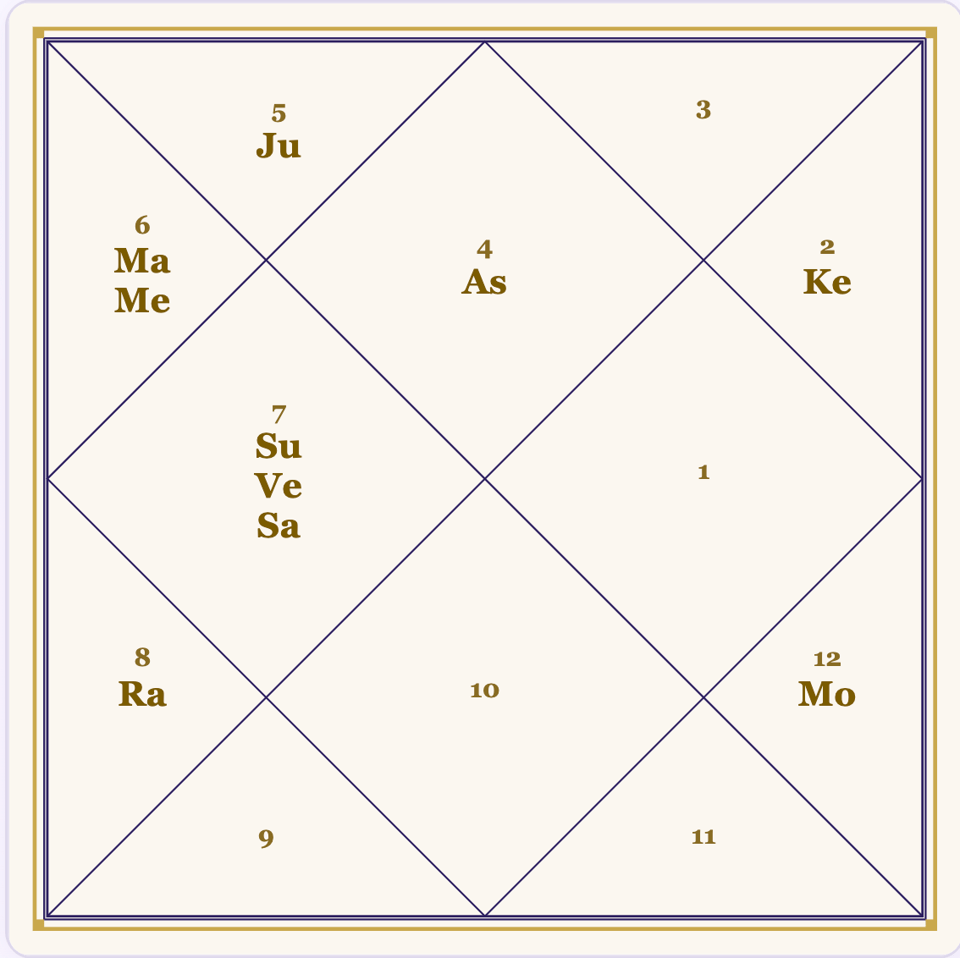
The chart of Bill Gates (co-founder of Microsoft and renowned technology magnate) demonstrates the conjunction variant of this principle. In his chart, the Sun occupies Libra, its sign of debilitation, in the Fourth House. Normally, a debilitated Sun in the house of happiness and domestic environment would suggest issues with property or emotional security. However, Venus, the lord of Libra, occupies the exact same house (the Fourth) in conjunction with the Sun. This creates the cancellation of debilitation wealth combination wherein the dispositor physically raises the debilitated planet.
Standard Parashari analysis initially appears problematic for wealth: the Second Lord (Moon) and Eleventh Lord (Venus) do not show direct connections to Trine lords (Jupiter, Mars, Moon). The connection flows through Saturn, who owns the Seventh and Eighth houses, which are not inherently wealth giving positions, though Saturn is exalted in the Seventh House. Yet the combination involving the Sun and Venus in the Fourth House creates the foundation for extraordinary wealth accumulation.
Additionally, the chart shows Ketu in the Eleventh House and Jupiter (the Ninth Lord) in the Second House, which contributes to wealth accumulation and preservation. The Fourth House position anchors the wealth in property and fixed assets, while the conjunction generates the massive fortune through technological innovation.
Pelé: Saturn in Debilitation with Mars Aspect
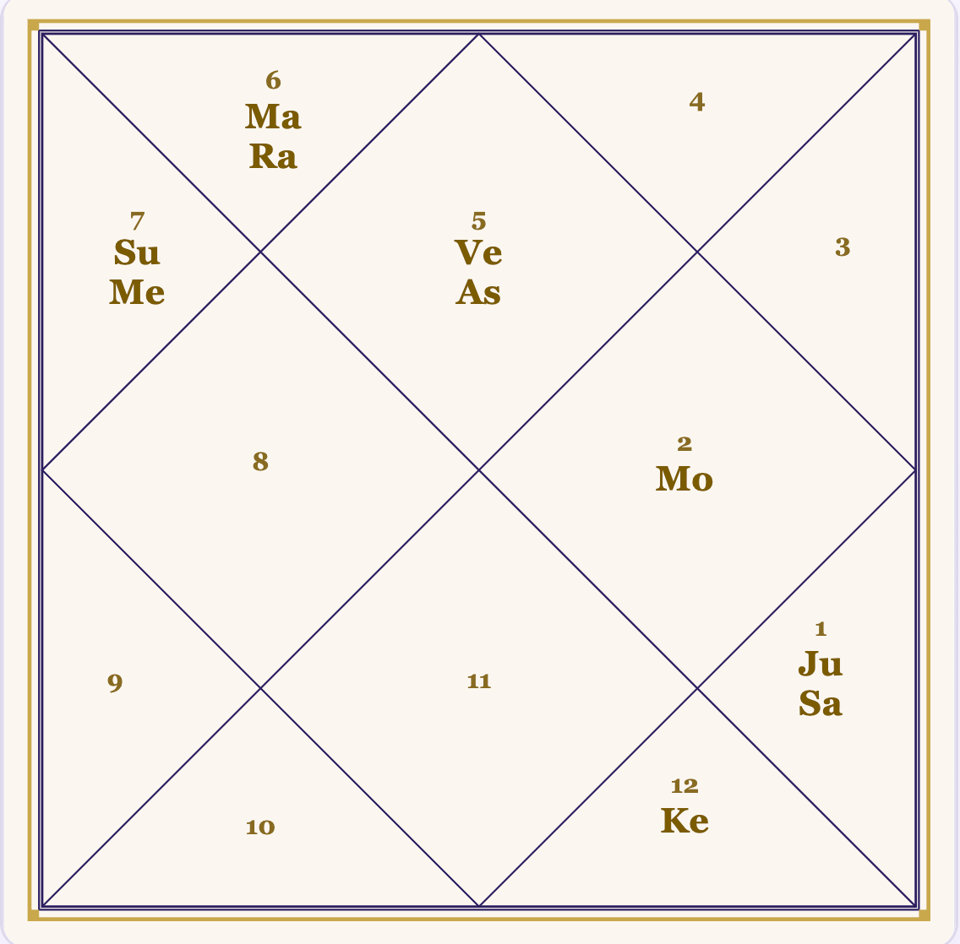
The chart of Pelé (the legendary Brazilian footballer widely regarded as one of the greatest players of all time) illustrates the aspect variant of this combination. In his horoscope, the Second and Eleventh Lord is Mercury, which is aspected by Jupiter (a Trine lord). However, the primary focus for the debilitated wealth rule falls on the Ascendant Lord Sun and Saturn.
Saturn occupies Aries, its sign of deep debilitation. Mars, the lord of Aries, casts its eighth aspect upon Saturn. This creates the wealth combination through the dispositor’s aspect rather than conjunction. The Sun is also debilitated in Libra (the Second House for Leo Ascendant), but its dispositor Venus does not occupy a quadrant from the Sun. Therefore, the working wealth combination specifically involves Mars aspecting Saturn.
While the native suffered significant health challenges throughout his life (indicated by the debilitated planets), the wealth giving potential manifested through the Mars Saturn relationship. Mars, as the dispositor, aspects Saturn from its position, fulfilling the requirement that the dispositor must see the debilitated planet. This configuration granted massive financial success and global status through sports, specifically football (Mars’s domain of competition and physical prowess), despite the physical suffering indicated by the debilitated Saturn.
Bruce Lee: Saturn in Debilitation with Dispositor in Quadrant
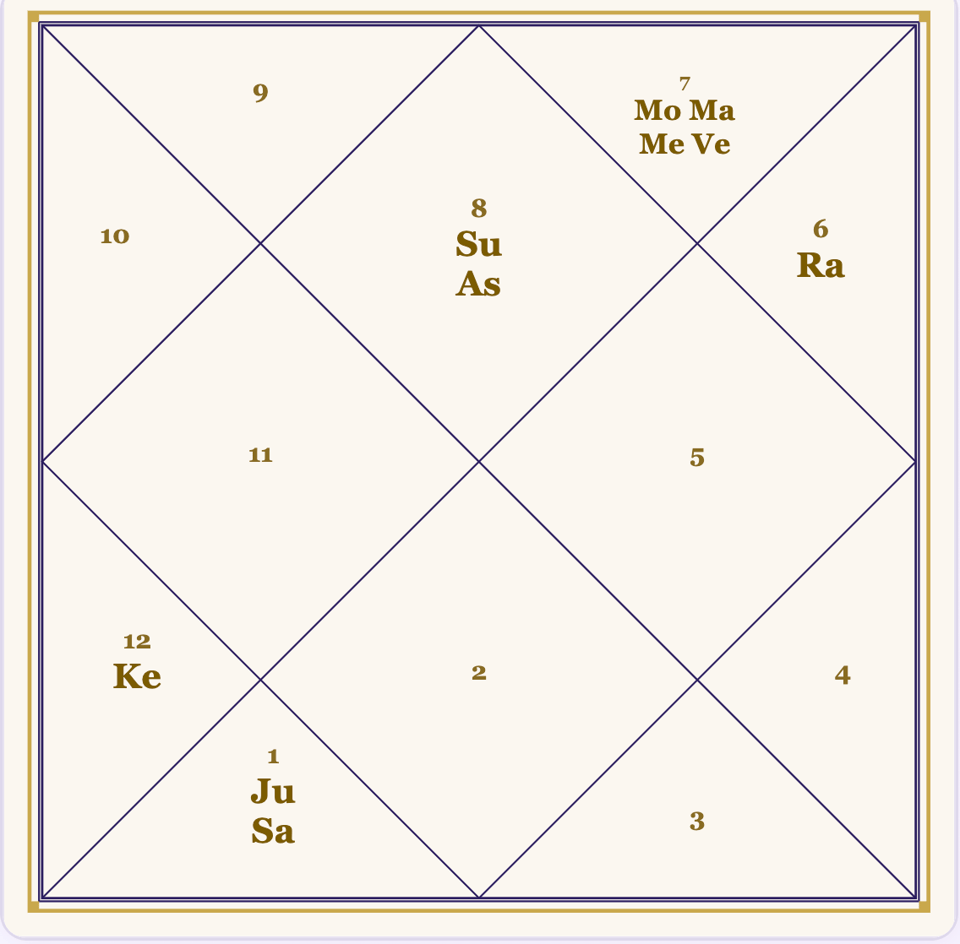
Bruce Lee’s chart (the iconic martial artist and film star who revolutionized action cinema) presents the cleanest geometric example of the quadrant placement rule. Saturn occupies Aries in the First House (Ascendant), creating debilitation in the house of self and physical vitality. Mars, the lord of Aries, occupies the Fourth House, which constitutes a quadrant from Saturn’s position in the First House. This four house separation represents the exact quadrant relationship required. Additionally, Mars aspects Saturn.
Beyond this combination, Lee’s chart contains standard Parashari wealth combinations: the Second Lord (Jupiter) and Eleventh Lord (Mercury) connect with Trine lords, and multiple Trine lords (Mars, Jupiter, and Moon) aspect each other. However, the debilitated combination adds the dimension of massive wealth accumulation capable of funding philanthropic endeavors. Lee donated millions to cancer research during his illness.
The placement of Saturn in the First House and Mars in the Fourth House creates a double quadrant effect that elevated Lee to legendary status and financial prosperity despite the physical vulnerability indicated by debilitated Saturn in the Ascendant.
Implementation: Checking Your Chart for Debilitated Wealth
Step 1: Identify Debilitated Planets
Examine your birth chart to identify any planets occupying their signs of debilitation: Sun in Libra, Moon in Scorpio, Mars in Cancer, Mercury in Pisces, Jupiter in Capricorn, Venus in Virgo, or Saturn in Aries. Note specifically whether these planets occupy quadrant houses or the Third, Sixth, or Eighth houses, as these positions amplify the wealth potential when the dispositor conditions are met.
Step 2: Locate the Dispositor
For each debilitated planet, identify its dispositor. For instance, if Venus is debilitated in Virgo, Mercury is the dispositor. If Saturn is debilitated in Aries, Mars is the dispositor.
Step 3: Analyze Dispositor Relationships
Check if the dispositor occupies a quadrant from the debilitated planet’s position. Count inclusively from the debilitated planet’s house: four houses away is the Fourth from it, seven houses away is the Seventh from it, and ten houses away is the Tenth from it. Alternatively, check if the dispositor conjoins the debilitated planet or aspects it directly (particularly the special aspects of Mars, Jupiter, and Saturn, or the standard seventh aspect for all planets).
Step 4: Synthesize with Standard Wealth Indicators
Confirm whether standard wealth combinations also exist (Second and Eleventh lords connected to Trine lords). The debilitated combination operates most powerfully when it supplements existing wealth potentials, though as seen in Bill Gates’ chart, it can function as the primary wealth engine even when standard indicators are weak or absent.
Conclusion
Debilitated planets represent not curses but concentrated potential that requires specific geometric keys to unlock. When a planet occupies its sign of debilitation and its dispositor occupies a quadrant from that planet, or conjoins or aspects it, the debilitation transforms into a powerful wealth combination capable of generating extraordinary wealth and status. This principle explains the financial success of individuals who possess multiple debilitated planets or severe debilitated positions that would traditionally be considered afflicted. The key lies not in the debilitation itself but in the dispositor’s willingness to elevate the fallen planet through quadrant placement or direct association. Rather than fearing debilitated planets, the astrologer must examine the chart for these specific cancellation configurations that indicate the native’s capacity to convert apparent weaknesses into sources of massive material prosperity.
Frequently Asked Questions
Can debilitated planets in my chart actually make me rich instead of poor? +
Yes, if your debilitated planet's dispositor (the lord of its debilitation sign) occupies a quadrant from that planet, or conjoins or aspects it, this creates a wealth combination. This configuration transforms the debilitation into a wealth giving combination, particularly if the debilitated planet occupies the First, Fourth, Seventh, or Tenth houses, or the Second and Eleventh houses of wealth.
What if my debilitated planet is not in a quadrant house? +
While the combination is strongest when the debilitated planet occupies a quadrant, the primary mechanic requires the dispositor to be in quadrant from the debilitated planet's position. If this geometric relationship exists, wealth can manifest even if the debilitated planet occupies other houses, though the quantity and stability may vary.
Which debilitated planet gives the most wealth? +
Saturn debilitated in Aries with Mars in quadrant or aspecting, and the Sun debilitated in Libra with Venus in conjunction or quadrant, prove particularly potent for massive wealth accumulation. However, any planet can generate this effect if the dispositor relationship aligns with the quadrant rules.
More Blog Articles
Continue reading related astrology guides.

Blog
Jupiter Transit in Cancer 2026–2027: Predictions for All Ascendants
Jupiter’s exalted transit in Cancer from 2026 to 2027 brings major changes in career, relationships, money, property, spirituality, and health for all ascendants in Vedic astrology.
9 May 2026

Blog
When Will You Get Pregnant? Vedic Astrology Guide to Childbirth Timing
Learn how Vedic astrology predicts pregnancy and childbirth timing through the 5th house, Jupiter transits, Vimshottari Dasha, Putrakaraka, and Saptamsa (D7) chart analysis.
8 May 2026
Blog
Saturn Transit in Revati Nakshatra 2026 (May 17–October 9): Karmic Shifts and New Beginnings
Saturn’s transit through Revati Nakshatra from May 17 to October 9, 2026, marks a major karmic turning point in Vedic astrology. The transit brings career changes, spiritual growth, relationship lessons, financial shifts, and important new beginnings for all ascendants.
7 May 2026